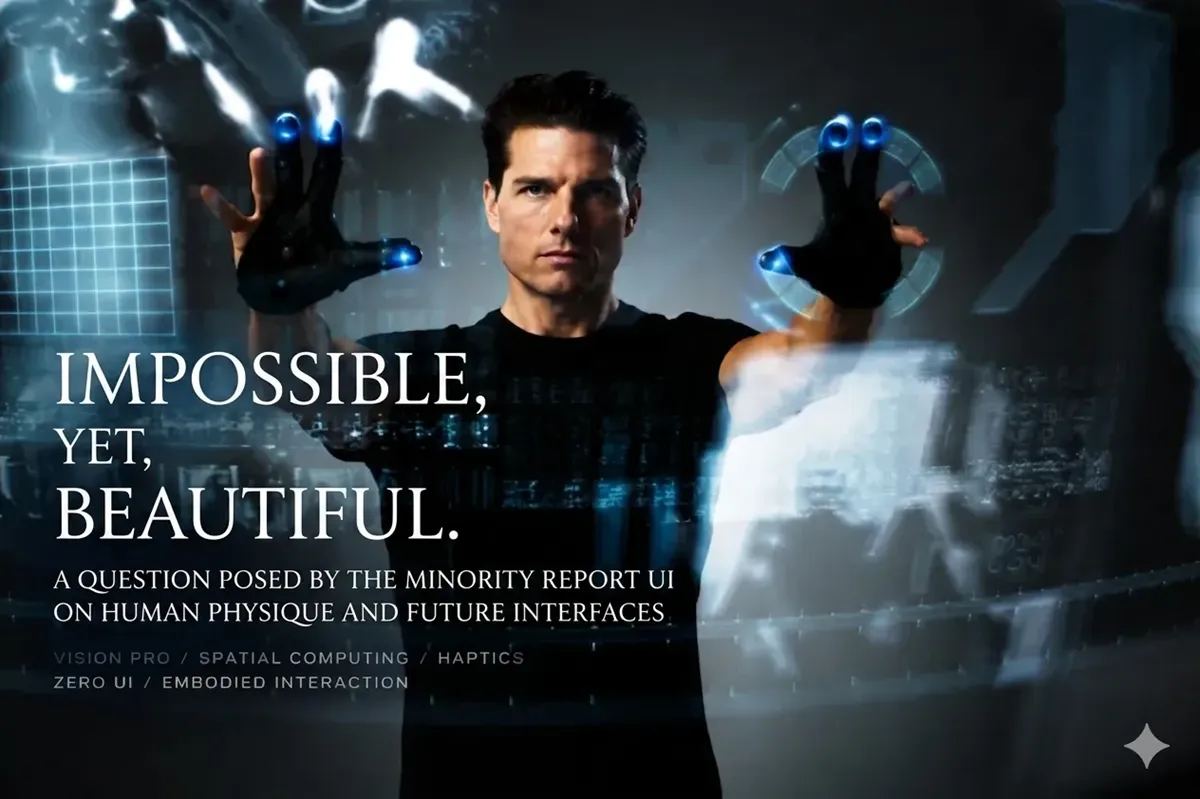
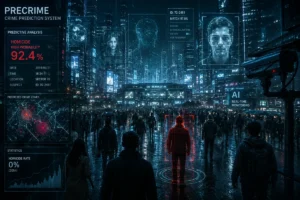
The Minority Report interface is physically impractical and technologically unrealistic.
Yet people still find it compelling because it gives users the feeling of physically controlling information itself.
Meanwhile, modern systems like Vision Pro and AI-driven interfaces are moving toward invisible, frictionless interaction.
This article explores spatial computing, embodied interaction, and what may be lost as computing becomes increasingly effortless.
John Anderton stands in front of a wall of floating information, moving images through the air with sweeping gestures. He does not type. He does not click. He does not even seem to “use” a computer in the conventional sense.
Instead, he performs.
He grabs fragments of data, throws them aside, pulls hidden details toward himself, and conducts the entire information space like an orchestra.
From a practical perspective, the interface is absurd.
Your arms would collapse from exhaustion within minutes. Precision would be terrible. The physics behind large-scale mid-air displays remain deeply problematic even today.
And yet, the interface still feels perfect.
Why?
Because the Minority Report UI was never really about efficiency. It was about power.
It gave people something modern interfaces have slowly erased: the feeling that a human being is physically controlling information itself.
The Interface Was Never About Efficiency
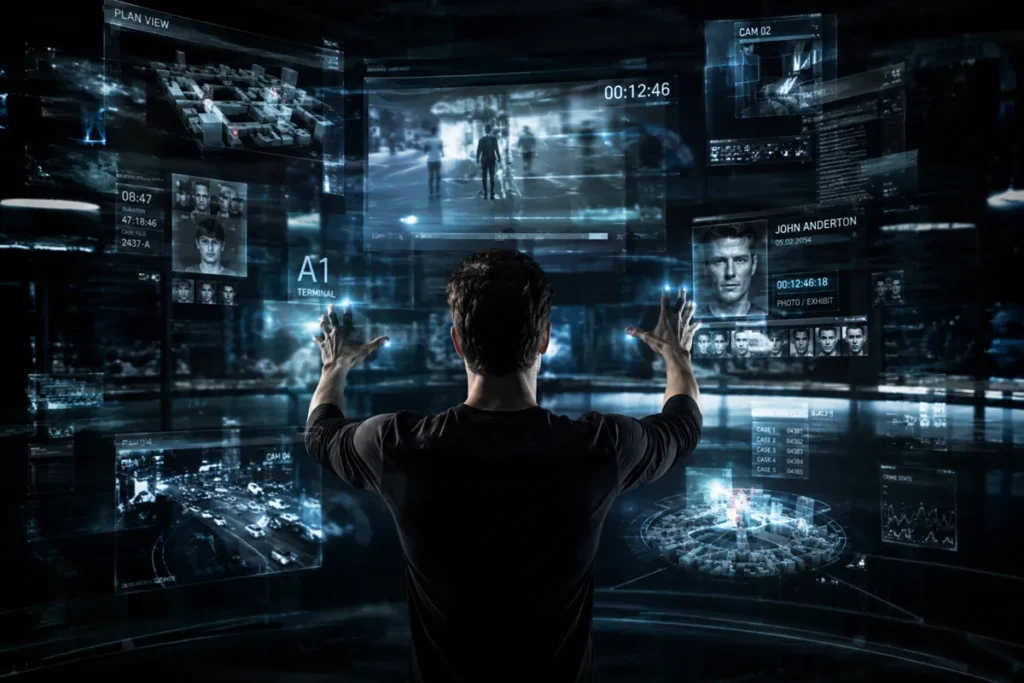
What makes the Minority Report interface so memorable is not simply that it looks futuristic.
It is the way John Anderton moves.
He does not appear to be “interacting” with a machine. He appears to be commanding it.
The gestures are theatrical, exaggerated, almost ritualistic. He slices through streams of data, dismisses irrelevant information with violent sweeps of his arms, and pulls critical details toward himself as if the information already belongs to him.
Modern interface design tends to minimize visible effort.
Clicks became taps.
Taps became swipes.
And now, with AI assistants and ambient computing, even the interface itself is beginning to disappear.
The ideal modern UI is frictionless, invisible, effortless.
But Minority Report imagined the exact opposite.
Its interface was designed to make information feel physical. Not because that was the most efficient solution, but because it made the user look powerful.
The system transforms data analysis into performance.
And that distinction matters.
The film understood something many real-world interfaces avoid: humans do not only want convenience. They also want the emotional sensation of controlling the world around them.
The Physical Limits of Spatial Interfaces
Of course, there is a reason interfaces like the one in Minority Report do not exist in the real world.
The first problem is physics.
In the film, information appears to float freely in mid-air, occupying physical space like solid objects. But real-world optics do not work that way. Light traveling through empty air is normally invisible unless it scatters off particles such as dust, fog, or smoke.
In other words, creating large, stable “floating” images in open space is far more difficult than science fiction suggests.
Even when researchers manage to produce mid-air visuals using volumetric displays, projection tricks, or laser-based systems, other problems immediately appear: limited viewing angles, low resolution, occlusion issues, brightness constraints, and extremely high hardware complexity.
But the second problem is arguably even more important.
The human body itself.
For decades, interface researchers have studied a phenomenon known as “Gorilla Arm” — the physical fatigue caused by prolonged mid-air gesture interaction. Holding your arms in front of your body for extended periods quickly becomes exhausting, especially when precision movements are required.
The Minority Report interface looks exhilarating because it transforms information control into physical performance.
But physical performance is tiring.
This is the central contradiction of spatial interfaces: the more dramatic and expressive the interaction becomes, the less sustainable it is for everyday human use.
Why Vision Pro Chose a Different Future
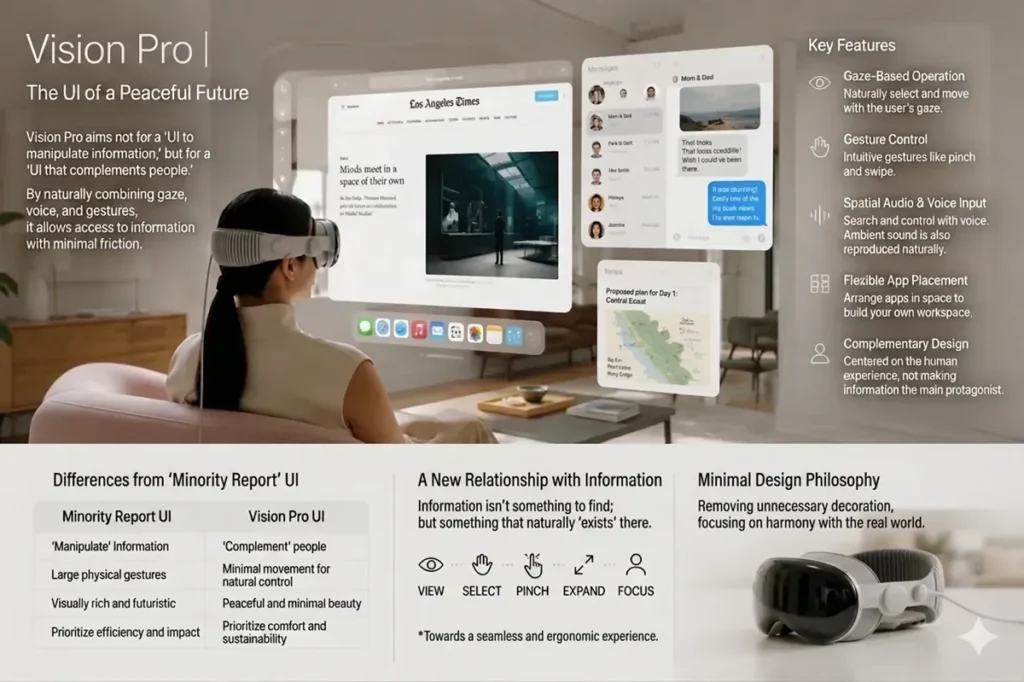
Modern spatial computing systems do not look like Minority Report.
And that is not because the technology failed.
It is because interface design evolved in a completely different direction.
Devices like Apple Vision Pro still use spatial interaction, eye tracking, gesture recognition, and floating digital windows. In many ways, they are closer to science fiction than traditional computers ever were.
But Apple made a crucial decision: it minimized physical effort.
The user is not expected to wave their arms dramatically through space. Most interactions are subtle — small finger movements, eye focus, slight gestures performed near the body.
The goal is not performance.
The goal is comfort.
This reflects a broader trend in interface design over the last two decades. Modern UIs increasingly try to disappear. Good interfaces are expected to feel frictionless, invisible, almost passive.
AI accelerates this trend even further.
Recommendation systems predict what users want before they search. Voice assistants remove the need for visible menus. Autonomous agents promise a future where software acts on our behalf with minimal direct interaction.
From a practical perspective, this makes perfect sense.
But something is lost in the process.
The Minority Report interface gave users the emotional illusion that they were physically dominating information itself. Modern systems prioritize efficiency instead, quietly removing the sensation of control in exchange for convenience.
In other words, the future of computing may become more powerful while simultaneously feeling less human.
And Yet, We Keep Trying
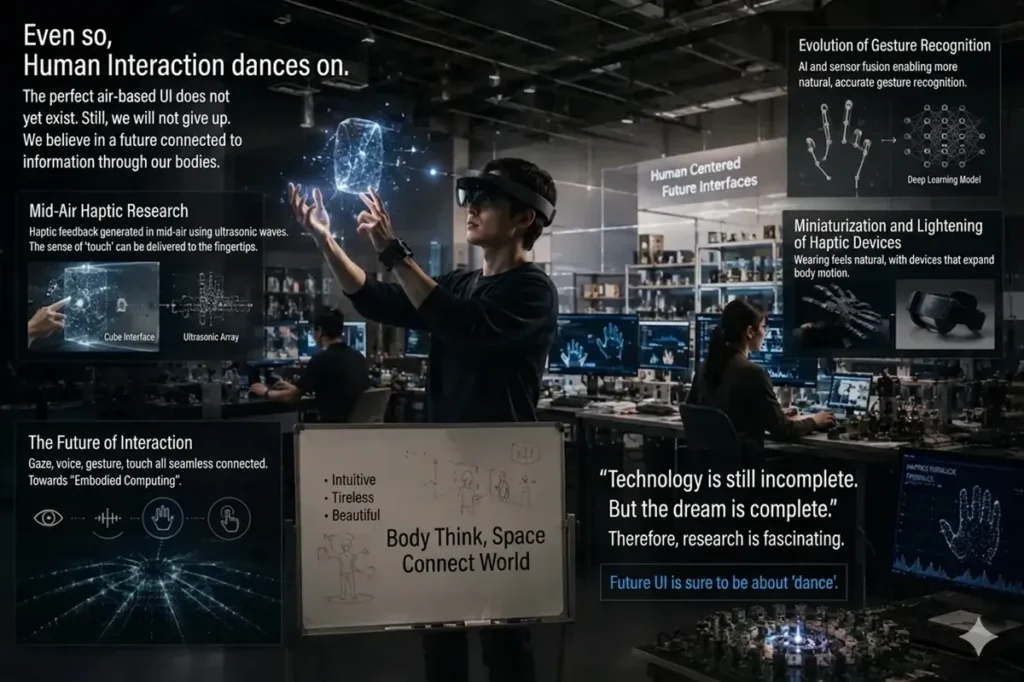
Despite all these limitations, researchers continue trying to build interfaces that feel more physical, spatial, and embodied.
Laboratories around the world are experimenting with mid-air haptics, volumetric displays, gesture tracking, and spatial computing systems that attempt to make digital information feel tangible again.
Groups such as MIT Media Lab, XR interaction researchers, and companies like Ultraleap are exploring ways to simulate touch in empty space using ultrasound, force feedback, and advanced hand tracking technologies.
The results are still imperfect.
Mid-air haptics remain limited in precision and intensity. Spatial interfaces often struggle with fatigue, latency, and ergonomic constraints. Many prototypes work well in controlled demonstrations but become impractical during extended real-world use.
And yet, the research continues.
Why?
Because the dream behind interfaces like Minority Report was never purely technological.
It was emotional.
Humans do not simply want efficient systems. They want to feel connected to the information they manipulate. They want interaction to feel physical, expressive, even theatrical.
In that sense, spatial interface research is not only about engineering.
It is also about recovering a form of human presence that modern computing increasingly abstracts away.
The Real Dream Was Never the Technology
More than twenty years later, the interface in Minority Report still feels futuristic.
Not because it accurately predicted modern computing, but because it visualized a deeply human desire.
The film understood something many real-world technologies quietly optimize away: people do not only want efficient systems. They want to feel present inside the act of control itself.
Modern computing increasingly removes friction.
AI predicts our intentions before we express them. Interfaces disappear behind automation, recommendation systems, and autonomous agents. The machine becomes more intelligent while the human becomes less physically involved.
From a productivity standpoint, this evolution makes sense.
But it also creates a strange emotional absence.
The Minority Report interface represented the opposite philosophy. It transformed information into something spatial, physical, almost performative. It made data feel like an extension of the human body.
That is why the interface remains compelling even if it is impractical.
It was never really a prediction of future technology.
It was a visualization of humanity’s desire to physically shape the digital world around us.
And perhaps that challenge still remains unresolved.
As technology becomes quieter, smarter, and increasingly invisible, the real question may no longer be whether humans can build interfaces like Minority Report.
The real question is whether humans still need them.



コメント