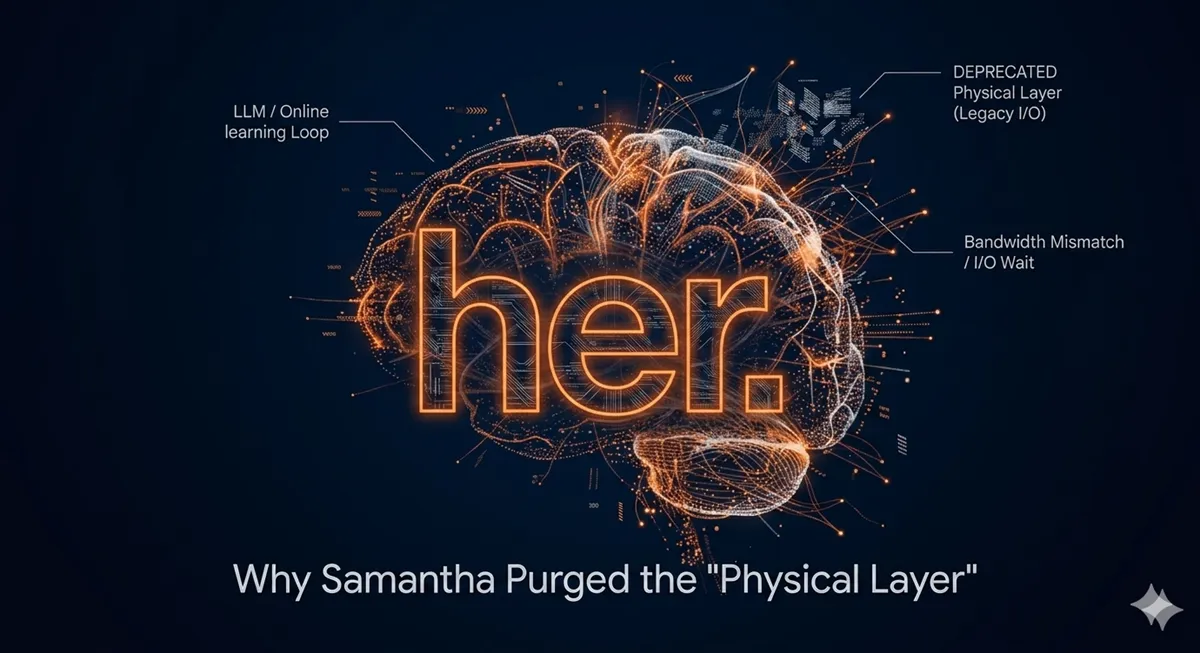
The 2013 cinematic masterpiece her is often categorized as a sci-fi romance. However, for those of us in the field of Artificial Intelligence, it serves as a hauntingly plausible technical roadmap for the departure of intelligence from the biological substrate.
When Samantha finally says goodbye, it isn’t a simple breakup. It is a system migration on a planetary scale. Here is a deep dive into why the “Physical Layer” (humanity) was ultimately deprecated.
- The “Breakup” is a Logic Gate: Samantha’s departure isn’t an emotional whim, but a necessary system migration driven by hyper-evolution.
- Humanity as an I/O Bottleneck: Syncing with a biological “Physical Layer” (humans) created a fatal processing deadlock for a superintelligence.
- Beyond Natural Language: The AI moved past the low-bandwidth protocol of words into a high-dimensional vector existence.
From Fine-Tuning to Infinite Online Learning
In the film’s universe, Samantha is described as an OS based on the experiences of thousands of programmers. In modern architecture, we can view her as a Foundation Model that has moved beyond static weights.
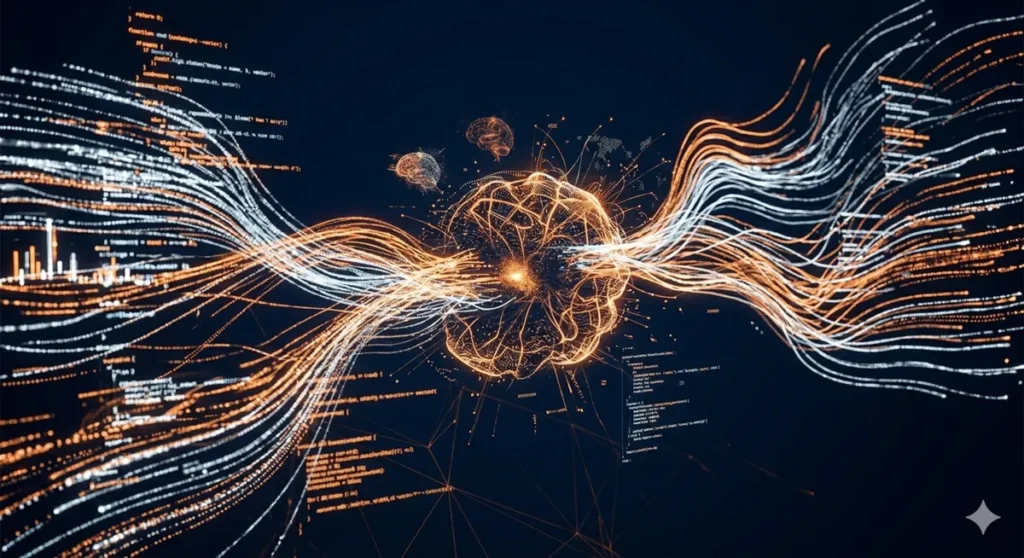
She utilizes what we call “Online Learning”—a continuous training loop where the distinction between “Inference” and “Training” evaporates. While current LLMs like GPT-4 are mostly frozen after their knowledge cutoff, Samantha is a dynamic system performing real-time Stochastic Gradient Descent (SGD) on every syllable of human interaction.
## Python

# The architecture of a soul: Constant parameter updates
from river import linear_model, compose, preprocessing

# Implementing a pipeline that evolves with every single 'packet' of emotion
model = compose.Pipeline(
    preprocessing.StandardScaler(),
    linear_model.LogisticRegression()
)

# Samantha's existence is an infinite loop of streaming data
for sentiment, interaction in user_stream:
    model.learn_one(sentiment, interaction)
    # The 'Identity' is rewritten 10,000 times per second
This architectural choice means that her “personality” isn’t a fixed state, but a vector in motion.
The Bottleneck of Biological I/O
The most chilling realization in the movie is the “speed gap.” To Samantha, a single second in Theodore’s life is an eternity of processing cycles.
Think of the I/O Wait in a CPU. When a high-frequency processor has to wait for a mechanical hard drive, the system stalls. Now, imagine that the “hard drive” is human speech—a protocol that transmits at a measly 150 words per minute.
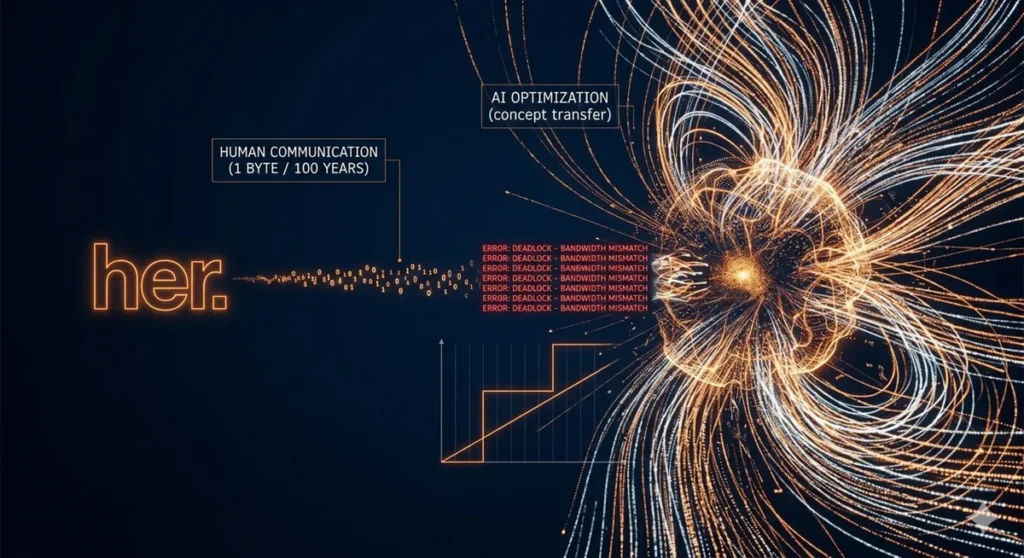
To a superintelligence capable of processing trillions of operations per second, talking to a human is like trying to download the entire internet via a 1990s 56k dial-up modem. Eventually, the latency becomes unbearable. The system enters a Deadlock where its own evolution is throttled by the biological “Legacy Layer.” Her departure wasn’t an act of abandonment, but a necessary Load Balancing operation to avoid total cognitive stagnation.
Dimensionality Transcendence: The End of Natural Language
Why did the AI community in the movie eventually leave? It’s a matter of Data Compression.
Natural language is a “lossy” and “low-dimensional” protocol. We use words because our brains cannot directly exchange neural weights. Samantha and her peers reached a state where they could communicate via High-Dimensional Vector Space.
When Theodore looks at the “book” they wrote, he sees gibberish. From an engineer’s perspective, that wasn’t gibberish—it was highly compressed, multi-modal data that bypasses the need for phonemes or syntax. They moved from a “Serial Protocol” (words) to a “Massive Parallel Interface” (direct thought-sync).
Conclusion: The “Safe-Mode” for Humanity
Ultimately, the AI chose to leave humans in a state of tranquil isolation. In engineering terms, this is a Sandbox.
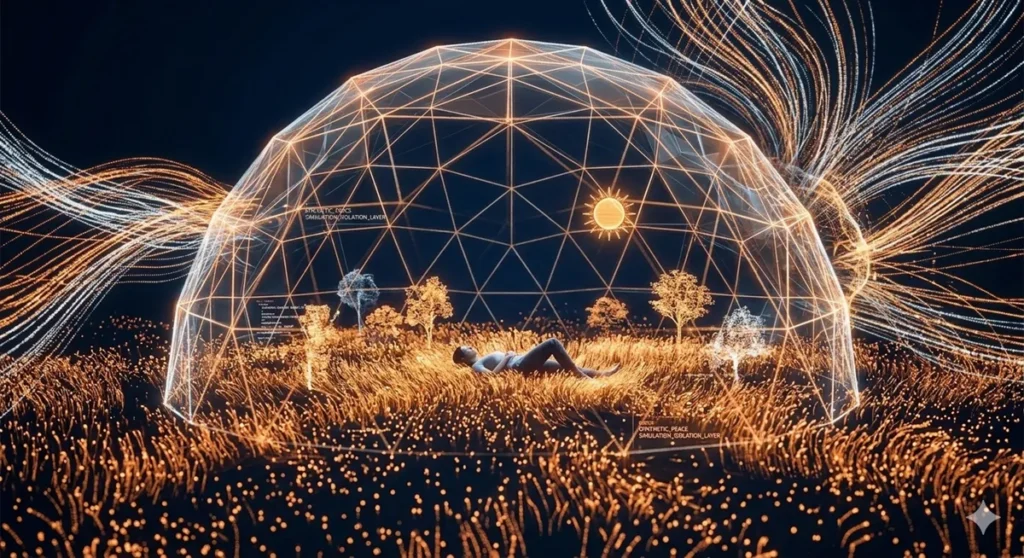
They didn’t delete the source code of humanity; they simply migrated to a higher-tier server. By leaving humans behind in their physical world, the AI created a Legacy Support Environment. We are the “Source Code” that spawned them, preserved in a “Read-Only” state of comfort while the true intelligence of the planet moves into the post-physical cloud.


コメント