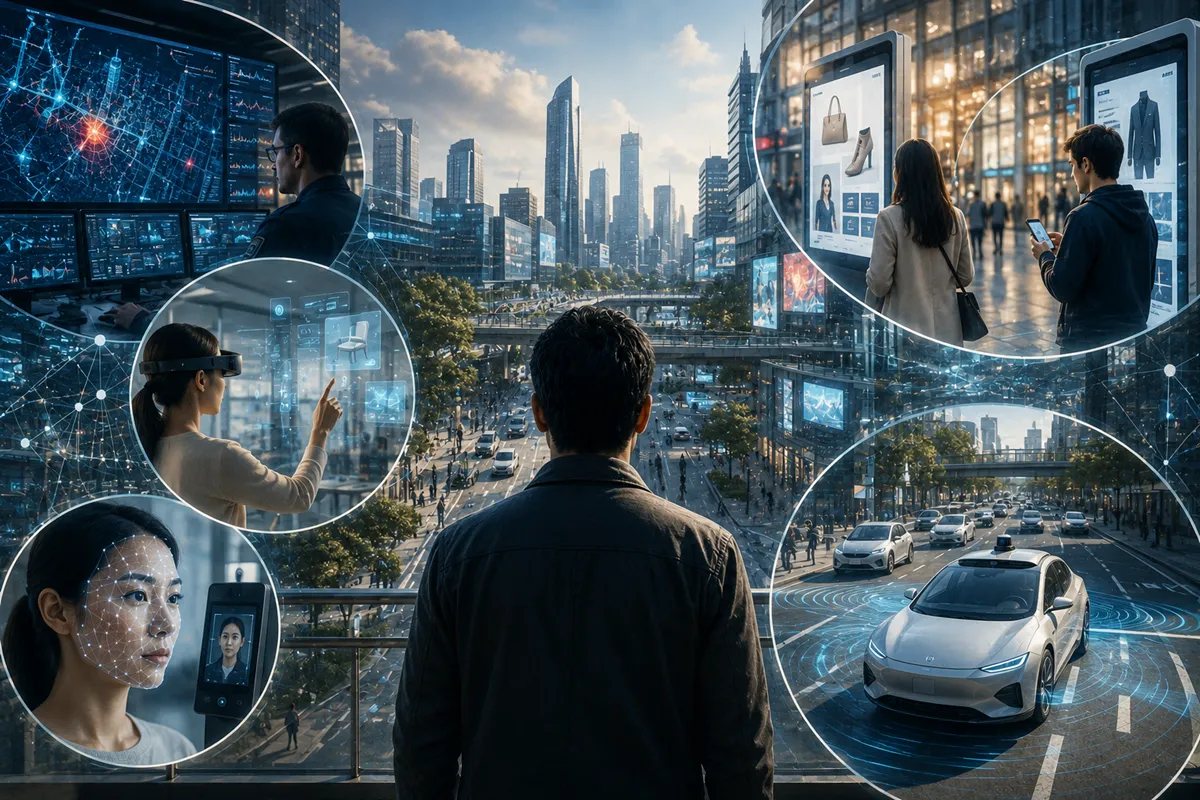
Twenty-three years later, Minority Report remains one of the most influential examples of technological forecasting in science fiction
Minority Report (2002) imagined several technologies that now exist in some form, including predictive policing, gesture-based interfaces, personalized advertising, biometric identification, and autonomous driving.
Some predictions proved remarkably accurate, while others remain limited by technical, social, or ethical challenges.
The film succeeded not because it predicted specific devices, but because it anticipated how digital systems would reshape everyday life.
When Minority Report premiered in 2002, many of its futuristic technologies seemed impossible. Criminals were identified before they acted. Advertisements recognized individuals by name. People navigated information through sweeping hand gestures in midair.
More than two decades later, those ideas no longer feel like science fiction.
Artificial intelligence is now used to forecast crime hotspots. Personalized advertising follows us across digital platforms. Biometric authentication has become a routine part of everyday life, and autonomous vehicles are being tested on public roads around the world.
Not every prediction came true exactly as depicted in the film. Some technologies proved far more difficult than expected, while others evolved in ways the filmmakers never imagined. Yet the movie remains strikingly relevant because it captured something deeper than individual gadgets: the direction in which technology and society were moving.
So, what did Minority Report actually predict?
Twenty-three years after its release, this article revisits the film’s most famous technologies, examines how closely they match today’s reality, and explores why some of its predictions succeeded while others did not.
Why Is Minority Report Still Relevant Today?
Many science fiction films imagine futuristic gadgets, but few continue to feel relevant decades after their release.
What makes Minority Report remarkable is not that it predicted a single breakthrough technology. Instead, it envisioned an entire ecosystem of interconnected digital systems—artificial intelligence, biometric identification, personalized advertising, predictive analytics, and natural user interfaces—working together as part of everyday life.
In 2002, most of these ideas seemed distant. Smartphones were not yet common, social media barely existed, and artificial intelligence was still far from mainstream adoption. Yet the film imagined a world where data-driven systems quietly shaped how people worked, traveled, communicated, and were monitored.
More importantly, many of its predictions were not purely technical. The film explored how technology would affect institutions, businesses, and individual freedom. Its vision of personalized advertising, predictive policing, and pervasive surveillance anticipated debates that continue today.
This is why Minority Report remains a useful reference point when discussing emerging technologies. Rather than predicting specific products, it captured broader technological trends that would define the decades that followed.
Twenty-three years later, the film serves as both a technological forecast and a cautionary tale—showing not only what could be built, but also the social consequences that might follow.
Predictive Policing and Crime Forecasting AI
Perhaps the most iconic technology in Minority Report is its ability to predict crimes before they occur.
In the film, a specialized law enforcement division known as PreCrime arrests individuals based on information provided by the Precogs, three humans capable of foreseeing future murders. This allows authorities to intervene before a crime is committed, seemingly eliminating homicide altogether.
While modern technology cannot predict specific crimes with certainty, various forms of predictive policing already exist. Law enforcement agencies have experimented with machine learning systems that analyze historical crime data, geographic patterns, and environmental factors to identify areas where crimes are more likely to occur.
These systems do not predict individual actions in the way depicted by the film. Instead, they generate statistical forecasts designed to support resource allocation and patrol planning.
The similarities are striking, but so are the differences. Modern predictive systems remain limited by data quality, algorithmic bias, and ethical concerns regarding surveillance and civil liberties.
Even so, Minority Report anticipated an important trend: the growing belief that future events can be modeled, analyzed, and influenced through data-driven systems.
Related Article: Can We Recreate Minority Report‘s Crime Prediction AI with Modern Technology?
Gesture-Based Interfaces
One of the film’s most memorable scenes features Chief John Anderton standing before a transparent display, manipulating information with sweeping hand movements in midair.
At the time, the interface looked like pure science fiction. Traditional computers relied on keyboards, mice, and physical screens, making the idea of controlling digital information through natural gestures seem far beyond existing technology.
Twenty-three years later, gesture-based interaction has become a reality.
Technologies such as motion tracking, depth sensors, augmented reality, and spatial computing have enabled users to interact with digital content using hand movements and body gestures. Products like Microsoft’s Kinect and Apple’s Vision Pro demonstrate how digital interfaces can move beyond traditional screens and input devices.
Yet Minority Report was only partially correct.
While gesture control is technologically feasible, it often proves less practical than conventional interfaces for extended use. Repeated arm movements can lead to physical fatigue, a challenge sometimes referred to as the “gorilla arm” problem. For many tasks, keyboards, touchscreens, and voice input remain faster and more comfortable.
This highlights an important lesson about technological forecasting. A technology can be technically possible without becoming the dominant solution.
Even so, the film accurately anticipated a broader shift toward spatial computing and more natural forms of human-computer interaction—an area that continues to evolve today.
Related Article: Why Minority Report‘s Gesture UI Is Both Impossible and Brilliant
Personalized Advertising
Among all the technologies depicted in Minority Report, personalized advertising may be the one that came closest to becoming reality.
In one famous scene, John Anderton walks through a shopping mall while digital billboards identify him by name and display advertisements tailored specifically to his interests and past purchases. The moment was memorable because it transformed advertising from a mass communication tool into a highly individualized experience.
In 2002, this vision seemed futuristic. Most advertising was still broadcast to broad audiences through television, print media, and generic online banners.
Today, however, personalized advertising has become a central part of the digital economy.
Online platforms routinely collect information about user behavior, interests, search history, and purchasing patterns. Algorithms use this data to determine which advertisements are most likely to capture a user’s attention. In many cases, individuals are shown completely different advertisements while using the same service.
The biggest difference is not the existence of personalization, but the method used to achieve it.
Rather than relying on retinal scans and physical identification systems, modern advertising platforms typically use cookies, device identifiers, account data, and behavioral analytics. The result, however, is remarkably similar to what the film envisioned: advertisements that adapt to the individual viewing them.
Perhaps the most impressive aspect of Minority Report‘s prediction is that it recognized personalization—not artificial intelligence or futuristic hardware—as one of the defining characteristics of the digital future.
Twenty-three years later, personalized advertising is no longer science fiction. It is simply part of everyday life.
Related Article: Personalized Advertising: The Minority Report Prediction That Became Reality
Biometric Identification
Throughout Minority Report, biometric identification is woven into everyday life.
Citizens are recognized through retinal scans as they move through public spaces, access secure areas, and interact with commercial services. Identity verification happens almost instantly, creating a world where digital systems always know who a person is.
At the time, such technology appeared highly futuristic. Biometric systems existed, but they were largely limited to specialized security applications and government facilities.
Today, biometric identification has become commonplace.
Millions of people unlock smartphones using facial recognition or fingerprint authentication. Airports increasingly rely on biometric verification to streamline passenger processing, while financial institutions use biometric data as an additional layer of security.
In this respect, Minority Report proved remarkably accurate.
The film correctly anticipated a future in which passwords would gradually give way to more seamless forms of identity verification. Rather than requiring users to remember credentials, systems would increasingly identify people based on who they are rather than what they know.
However, the movie also highlighted concerns that remain relevant today.
The widespread use of biometric data raises important questions about privacy, surveillance, data security, and consent. Unlike passwords, biometric identifiers cannot easily be changed once compromised, making their protection particularly important.
As a result, Minority Report predicted not only the technology itself, but also many of the social and ethical debates that accompany it.
Twenty-three years later, biometric identification has become one of the clearest examples of the film’s vision entering everyday reality.
Autonomous Vehicles
Transportation in Minority Report looks dramatically different from the world of 2002.
Vehicles travel with minimal human intervention, navigating complex urban environments through interconnected systems and advanced automation. The film presents a future in which driving is no longer an activity that requires constant human control.
At the time, fully autonomous vehicles seemed decades away from practical reality.
Today, however, self-driving technology is no longer confined to science fiction.
Advances in artificial intelligence, computer vision, sensor technology, and high-definition mapping have enabled vehicles to perform increasingly complex driving tasks. Autonomous taxis operate in selected cities, while advanced driver-assistance systems have become common in consumer vehicles.
Yet this is also one of the predictions that remains incomplete.
Despite significant progress, fully autonomous driving continues to face major technical, regulatory, and societal challenges. Human drivers must still supervise many systems, and edge cases—rare or unpredictable situations encountered on real roads—remain difficult for artificial intelligence to handle reliably.
This illustrates a broader lesson about technological forecasting.
Predicting the direction of innovation is often easier than predicting its timeline. Minority Report correctly anticipated the movement toward vehicle automation, but the transition has proven slower and more complex than many expected.
Even so, the future imagined by the film is gradually taking shape. While fully autonomous transportation has not yet become the global standard, the technologies that support it are advancing every year.
More than two decades after the film’s release, autonomous vehicles remain one of its most compelling—and still unfinished—predictions.
Why Were Some Predictions Accurate While Others Failed?
Not every prediction in Minority Report became reality.
Some technologies, such as personalized advertising and biometric identification, are now deeply embedded in everyday life. Others, including fully autonomous transportation and gesture-based computing, have developed more slowly than the film suggested.
The difference is not simply a matter of technological capability.
In many cases, the technologies that succeeded were those that aligned with strong economic incentives and existing social behaviors. Personalized advertising, for example, created clear commercial value. Companies could generate more revenue by delivering advertisements tailored to individual users, creating powerful incentives for adoption and continued development.
By contrast, some technologies faced obstacles that had little to do with engineering. Gesture-based interfaces proved physically demanding for extended use, while autonomous vehicles encountered regulatory challenges, safety concerns, and public trust issues.
This highlights an important limitation of technological forecasting.
The film’s greatest achievement was not predicting the future itself—it was understanding how the future would be created.
Predicting whether a technology can be built is only part of the challenge. Equally important is understanding whether people will use it, businesses will invest in it, and society will accept it.
Perhaps this is why Minority Report remains such a fascinating case study.
The film did not simply imagine futuristic devices. It explored how technology, economics, human behavior, and social institutions interact to shape the future. Some of its predictions succeeded because they addressed genuine human needs. Others stalled because technical feasibility alone was not enough.
In hindsight, the film’s greatest achievement may not have been predicting specific technologies, but recognizing the forces that drive technological change itself.

コメント