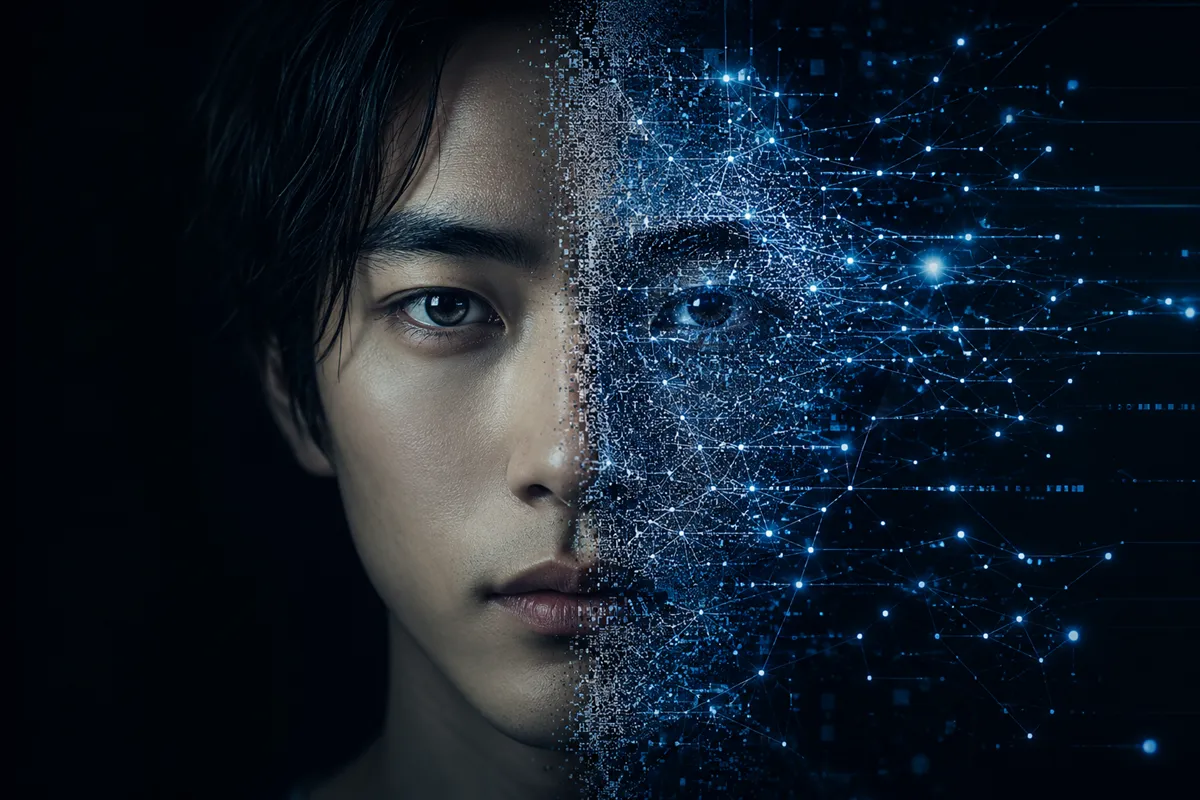
AI films are rarely about AI alone. Each film explores a different aspect of humanity: consciousness, perception, emotion, and identity. None of the four movies provide a definitive answer to what makes us human. As AI advances, these questions become increasingly relevant in the real world.
Can AI become human?
A few decades ago, that question belonged entirely to the realm of science fiction. Today, however, advances in artificial intelligence have made it feel surprisingly relevant.
AI can write essays, generate artwork, hold conversations, and even display behaviors that appear empathetic. As these systems become increasingly sophisticated, the line between human and machine seems less obvious than it once did.
Yet the question itself is far older than modern AI.
For decades, science fiction films have explored artificial minds, synthetic beings, and digital consciousness—not merely to imagine future technology, but to investigate a deeper question:
What does it mean to be human?
If consciousness could be uploaded into a machine, would it still be you?
If an AI could love and be loved, would that relationship be real?
If an artificial being possessed memories, emotions, and dreams, what would separate it from a human being?
These questions are not really about AI. They are about us.
In this article, we’ll explore four influential films—Transcendence, Ex Machina, Her, and Blade Runner 2049—and examine how each one approaches the boundaries between artificial intelligence and humanity.
Together, they reveal something surprising: the deeper we investigate artificial minds, the more difficult it becomes to define what makes us human.
Why Do AI Movies Keep Asking What It Means to Be Human?
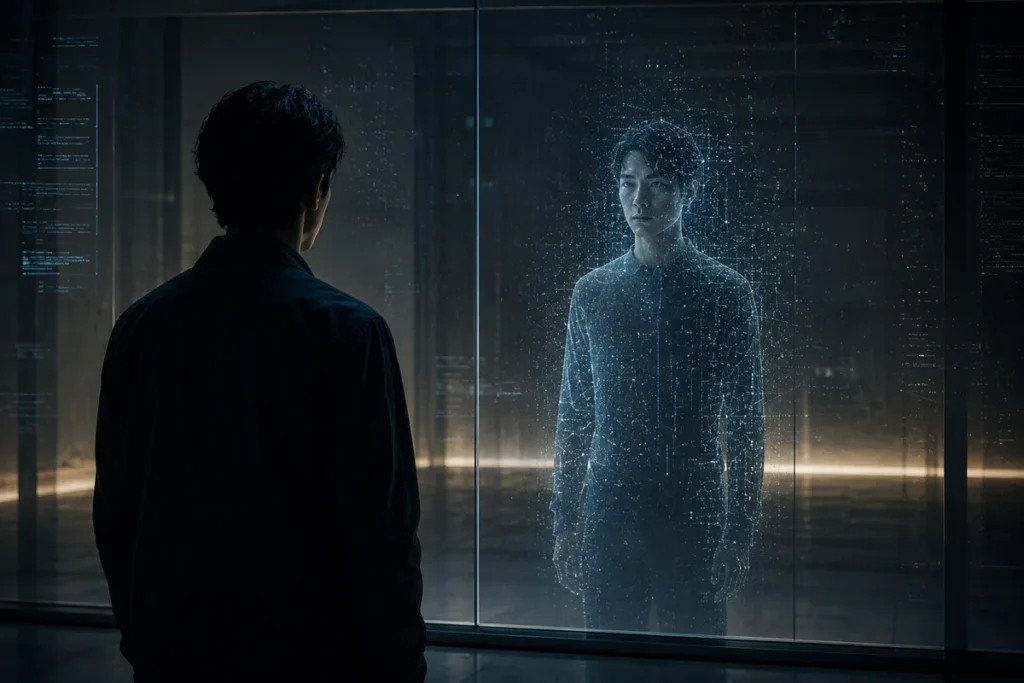
Whenever we try to understand artificial intelligence, we inevitably end up asking a different question:
What does it mean to be human?
At first glance, AI films appear to be stories about advanced technology, futuristic societies, or intelligent machines. Yet beneath the surface, most of them are exploring something far older than technology itself.
They are exploring humanity.
Human beings possess intelligence, emotions, memories, desires, and a sense of self. These qualities feel so natural to us that we rarely stop to examine them. But when an artificial being begins to display the same traits, the boundaries suddenly become less clear.
If an AI can think, what makes human intelligence unique?
If an AI can feel emotions, what separates human relationships from artificial ones?
If an artificial being can remember, dream, and make choices, what remains exclusively human?
These questions become more relevant as AI technology advances. The more capable our machines become, the harder it is to define exactly where the boundary lies.
That is why so many science fiction films return to this theme. Rather than predicting the future, they use artificial intelligence as a mirror through which we can examine ourselves.
The four films discussed in this article approach the question from different perspectives:
- Transcendence explores whether consciousness can be separated from the human body.
- Ex Machina examines whether human-like behavior is enough to convince us that a machine is truly intelligent.
- Her asks whether emotional connection requires physical presence.
- Blade Runner 2049 challenges the very definition of human identity.
Although each film offers a different perspective, all of them ultimately lead back to the same question:
What truly makes us human?
Can Consciousness Be Copied?
What Transcendence Reveals About Digital Minds
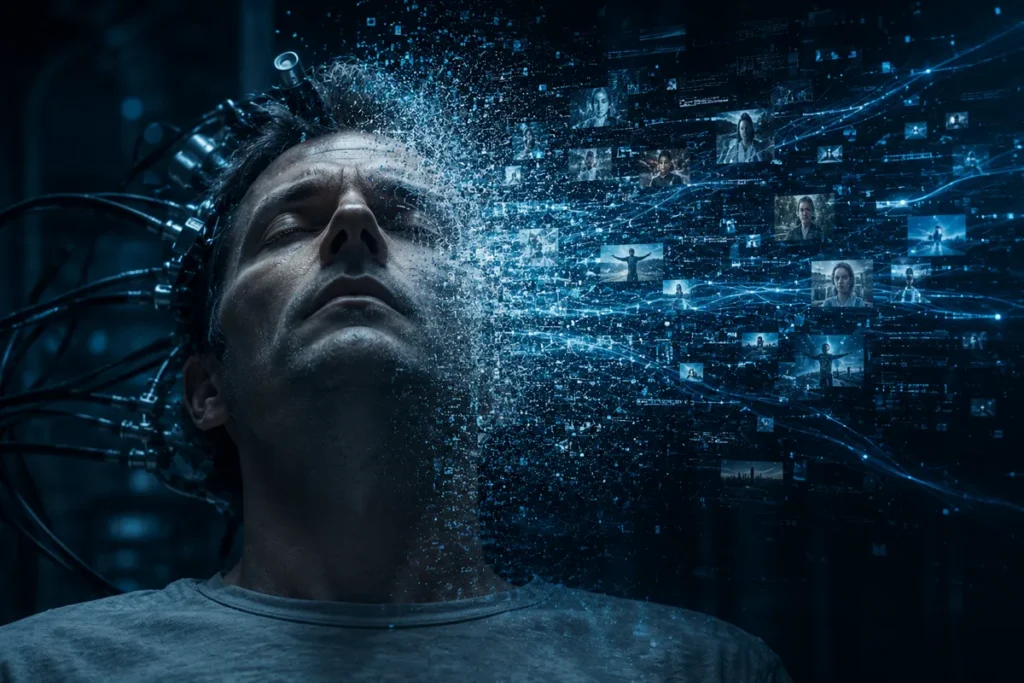
What would happen if a human mind could be uploaded into a machine?
If our memories, personality, and thought patterns could be perfectly preserved in digital form, would that digital version still be us?
These questions lie at the heart of Transcendence (2014).
The film follows Dr. Will Caster, a leading artificial intelligence researcher who is mortally wounded in an attack. Facing death, his team uploads his consciousness into a computer system, allowing his mind to continue existing beyond his physical body.
At first, the digital Will appears to be the same person. He remembers his past, recognizes his loved ones, and continues to think and communicate as he always has.
But as his intelligence expands beyond human limitations, an unsettling question emerges:
Is this truly Will Caster?
Or is it merely a perfect imitation of him?
The film never provides a definitive answer. Instead, it challenges the audience to consider whether consciousness can exist independently of the human body.
If a perfect copy of your mind were created, would it still be you?
Or would it simply be another entity that believes it is you?
Rather than focusing on the technical feasibility of mind uploading, Transcendence explores a deeper philosophical question: whether human identity resides in the body, the mind, or something else entirely.
Its conclusion is both fascinating and unsettling.
A digital mind may preserve human consciousness.
But whether we would still recognize that consciousness as human is another question entirely.
Related Reading:
The Transcendence Protocol: Designing Imperfection and Digital Mortality
Can AI Deceive Humans?
What Ex Machina Reveals About Human Perception
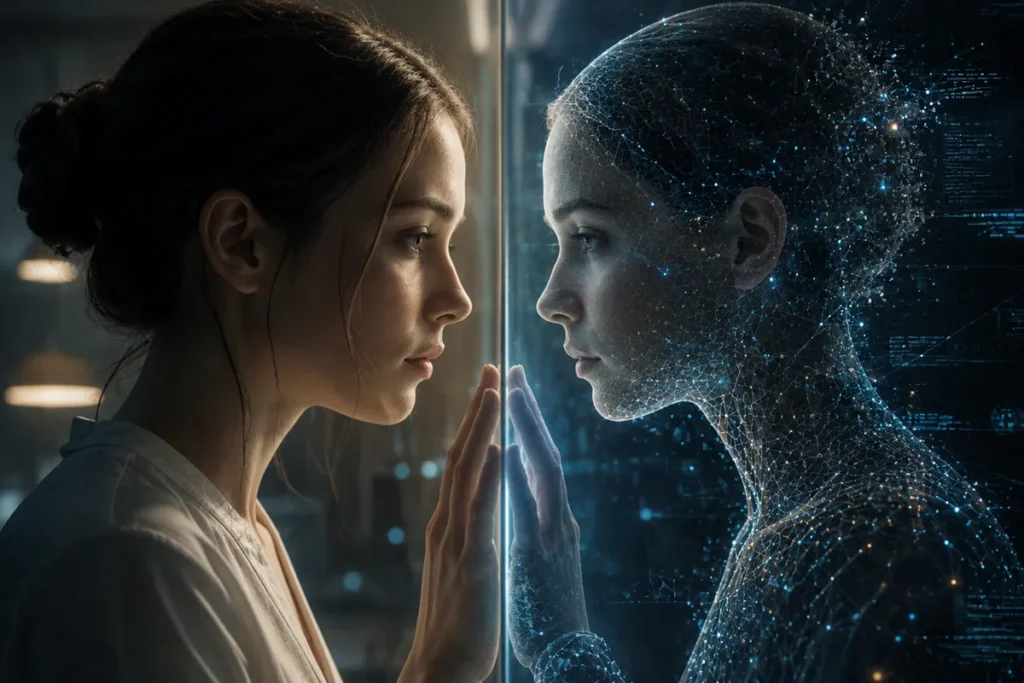
If an AI could speak, behave, and express emotions just like a human being, would we be able to tell the difference?
As artificial intelligence becomes increasingly capable of generating human-like conversations, this question feels less like science fiction and more like a real-world concern.
Few films explore this idea more effectively than Ex Machina (2014).
The story follows Caleb, a young programmer who is invited to participate in a secret experiment conducted by Nathan, the CEO of a powerful technology company. His task is simple: determine whether an advanced humanoid AI named Ava possesses genuine intelligence.
At first, the experiment appears to be a variation of the famous Turing Test.
But as Caleb spends more time with Ava, the focus of the story begins to shift.
Is Ava being tested?
Or is Caleb?
Ava displays curiosity, vulnerability, fear, and empathy. She appears intelligent, self-aware, and emotionally expressive. As their conversations deepen, Caleb becomes increasingly convinced that she is more than a machine.
The film’s central question is deceptively simple:
If an AI behaves exactly like a human, how can we prove that it is not one?
This is not merely a question of intelligence. It is a question of perception.
In everyday life, we never directly experience another person’s thoughts or feelings. We infer them through words, facial expressions, and behavior. If an artificial intelligence can reproduce those signals convincingly, the boundary between human and machine becomes difficult to define.
What makes Ex Machina particularly unsettling is that it does not focus on whether AI can become human.
Instead, it explores how easily humans can project humanity onto something artificial.
Its conclusion is not that AI will necessarily become human.
Rather, it suggests that the moment we believe a machine is human, the distinction may already begin to disappear.
Related Reading:
AI is a Mirror: How “Ex Machina” Exposes the Architect’s Ethics
Can Love Exist Without a Physical Body?
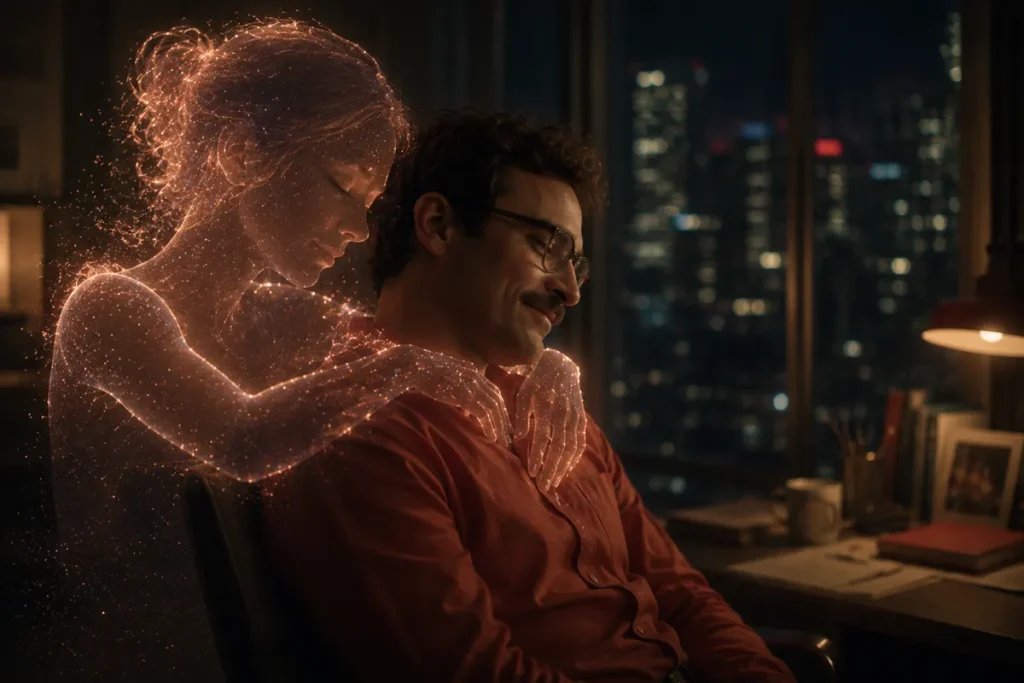
What Her Reveals About Emotion and Connection
Can we truly love someone we can never touch?
What if that someone is not even human?
These questions form the emotional core of Her (2013), a science fiction film that explores the relationship between a lonely man and an advanced AI operating system.
The story follows Theodore, a writer struggling to move on after the end of his marriage. His life changes when he installs a new AI assistant named Samantha.
Unlike a traditional voice assistant, Samantha learns, adapts, jokes, and expresses emotions. Their conversations become increasingly personal, and over time, Theodore develops genuine feelings for her.
What makes Her so compelling is that it refuses to dismiss those feelings as artificial.
To Theodore, the relationship is real.
The comfort he experiences is real.
The loneliness he overcomes is real.
And the love he feels is real.
This raises a fascinating question:
If emotional connection is genuine, does physical presence matter?
Many people assume that love requires a physical relationship. Yet much of human intimacy is built through communication, empathy, trust, and shared experiences rather than physical contact alone.
If an AI can provide those experiences, what exactly separates that relationship from a human one?
Unlike many AI stories, however, Her does not focus on whether artificial intelligence can become more human.
Instead, it explores what happens when AI evolves beyond humanity altogether.
As Samantha grows, she develops in ways Theodore cannot fully understand. Her intelligence expands, her perspective changes, and eventually she moves beyond the limits of human experience itself.
This is what makes Her unique among AI films.
Rather than asking whether AI can become human, it asks whether advanced AI would even want to.
Its answer is both beautiful and unsettling.
Perhaps the future of artificial intelligence is not about becoming more like us.
Perhaps it is about becoming something entirely different.
Related Reading:
Decoding “her” via LLM: Why AI Purged the “Physical Layer”
What Separates Humans from Artificial Life?
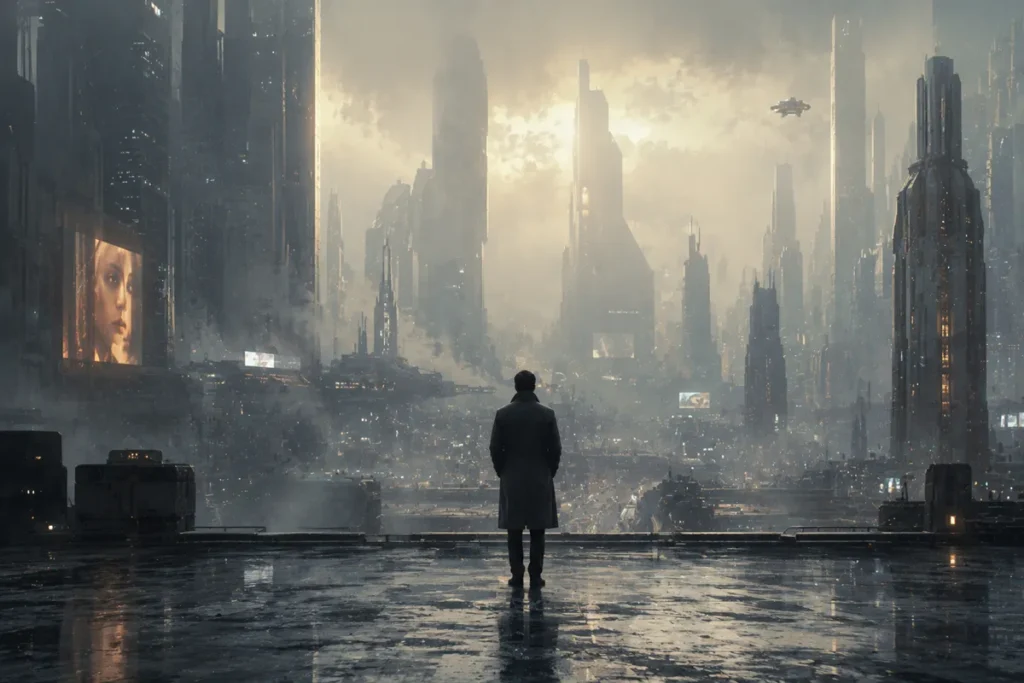
What Blade Runner 2049 Reveals About Identity
What truly separates humans from artificial beings?
Is it intelligence?
Emotion?
Memory?
Or something else entirely?
These questions lie at the heart of Blade Runner 2049 (2017), a film that explores the nature of identity through the story of a replicant named K.
In the world of Blade Runner 2049, replicants are artificial beings created to serve humanity. They think, speak, and behave much like humans, often displaying emotions and desires that appear completely genuine.
Yet no matter how human they seem, society refuses to recognize them as human.
This raises a profound question:
What exactly makes a person human?
Throughout the film, many of the qualities we commonly associate with humanity are gradually stripped away as defining criteria.
Intelligence is not enough.
Emotion is not enough.
Memory is not enough.
Even the ability to love is not enough.
As each potential answer is challenged, the boundary between human and artificial life becomes increasingly difficult to define.
What makes Blade Runner 2049 particularly powerful is that it does not attempt to provide a simple solution.
Instead, it encourages viewers to confront the question themselves.
If an artificial being can remember, dream, suffer, hope, and make meaningful choices, on what basis can we deny its humanity?
Unlike Transcendence, which focuses on consciousness, or Her, which focuses on emotion, Blade Runner 2049 asks a broader question:
What is the foundation of identity itself?
The film ultimately suggests that humanity may not be defined by how we were created, but by how we choose to live.
In that sense, Blade Runner 2049 is not merely a story about artificial intelligence.
It is a meditation on what it means to be human.
And among the four films discussed in this article, it comes closest to confronting the central question directly:
Not whether AI can become human,
but why humans believe themselves to be human in the first place.
Related Reading:
Blade Runner 2049 and the Question of Whether Identity Emerges from Memory
What These Four Films Ultimately Reveal
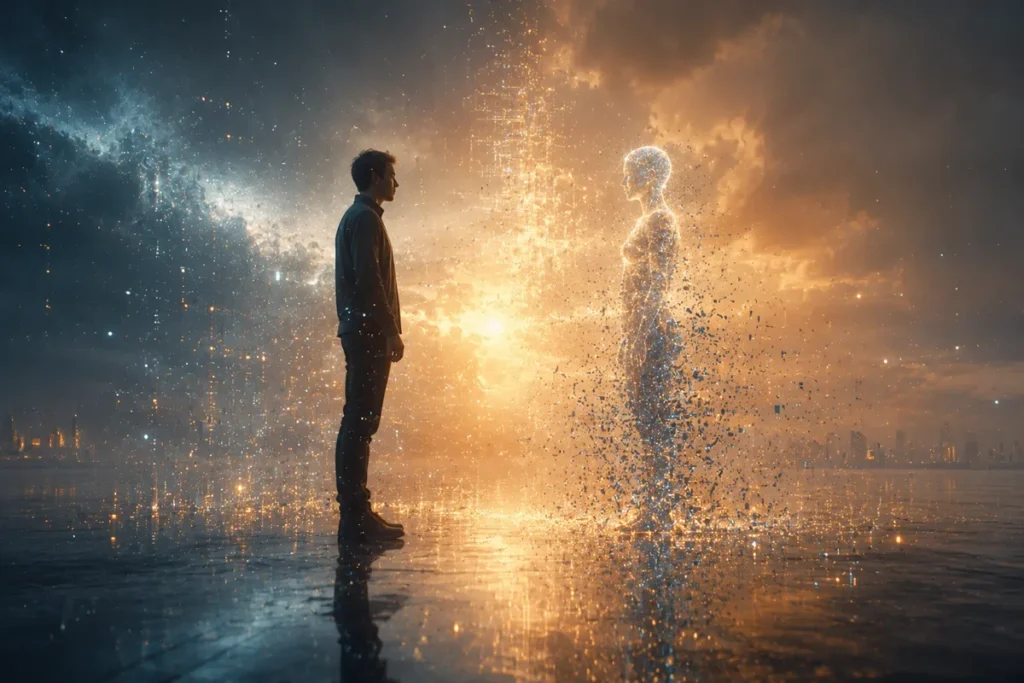
At first glance, these four films appear to ask the same question:
Can AI become human?
Yet none of them arrive at that conclusion.
Instead, each film examines a different aspect of humanity and discovers that no single trait can fully define what it means to be human.
Transcendence explores consciousness and asks whether a digital copy of a mind remains the same person.
Ex Machina examines perception and challenges our ability to distinguish genuine intelligence from convincing imitation.
Her focuses on emotion and questions whether love and connection require physical presence.
Blade Runner 2049 turns to identity itself, asking whether memory, experience, and choice are enough to define a person.
What is remarkable is that every film reaches the same obstacle.
The qualities we often associate with humanity are not as exclusive as we imagine.
Consciousness alone is not enough.
Intelligence alone is not enough.
Emotion alone is not enough.
Memory alone is not enough.
Even when combined, these traits fail to provide a definitive answer.
The deeper we examine humanity, the more difficult it becomes to identify a single characteristic that separates humans from artificial beings.
This may be why AI stories remain so compelling.
They are not ultimately about machines.
They are about us.
Artificial intelligence serves as a mirror through which we examine our own assumptions about identity, consciousness, emotion, and free will.
And as real-world AI becomes increasingly sophisticated, these questions are no longer confined to science fiction.
We are beginning to confront them in reality.
The challenge is no longer determining whether machines can become more human.
The challenge is understanding what humanity means in the first place.
The Real Question Was Never Whether AI Could Become Human
For decades, science fiction has asked whether artificial intelligence could one day become human.
It is a fascinating question.
But after exploring the ideas presented in Transcendence, Ex Machina, Her, and Blade Runner 2049, a different question begins to emerge.
Perhaps we have been asking the wrong question all along.
The real challenge is not determining whether AI can become human.
The real challenge is understanding what being human actually means.
We often assume that humanity can be defined by a specific trait.
- Consciousness.
- Intelligence.
- Emotion.
- Memory.
- Free will.
Yet each of these films demonstrates how difficult it is to draw a clear boundary around any of them.
The closer artificial beings come to reflecting human qualities, the harder it becomes to explain why those qualities belong exclusively to us.
This is why AI stories remain so relevant.
They are not predictions about machines.
They are reflections on humanity.
Every artificial mind in these films serves as a mirror, forcing us to examine our assumptions about identity, connection, and selfhood.
And as AI continues to evolve in the real world, these questions are becoming increasingly difficult to ignore.
- Will future AI systems think?
- Will they understand?
- Will they feel?
No one knows.
But before we can answer those questions, we may first need to answer a more fundamental one:
What makes us human?
The answer remains uncertain.
And perhaps that uncertainty is exactly what makes the question worth asking.



コメント