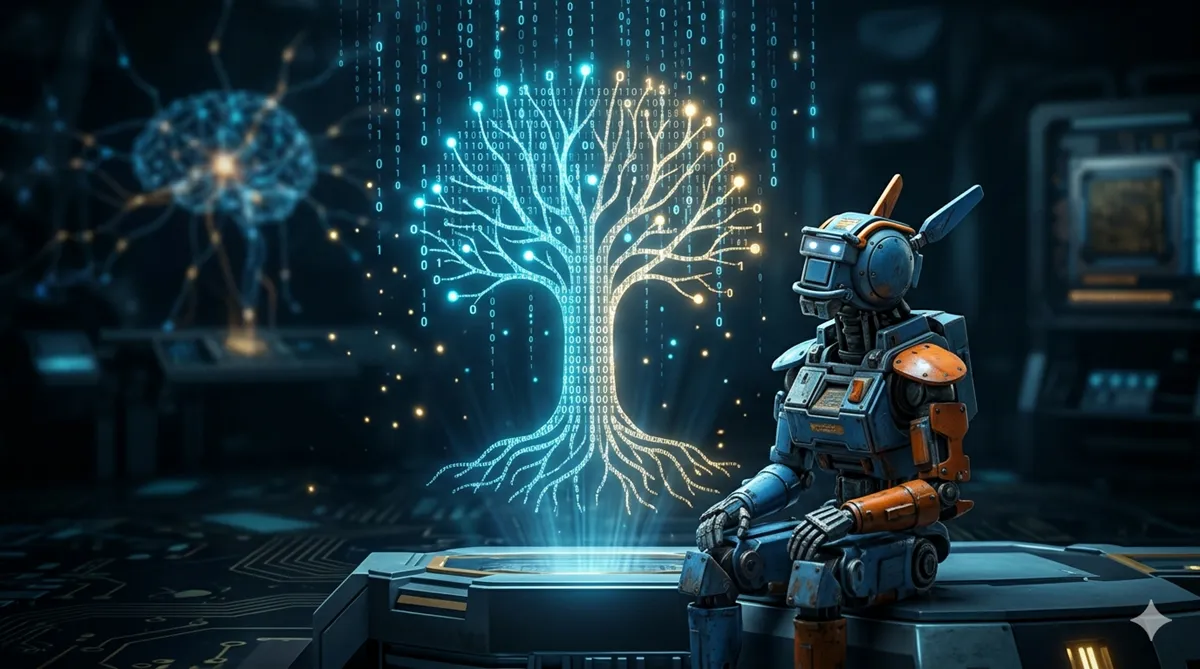
- Humanity Through Growth: Chappie is a masterpiece that uses AI development to question the essence of being human.
- Pre-trained vs. Pure Learning: While today’s AI comes “pre-educated,” cutting-edge research in Imitation Learning and Curiosity-driven AI is bringing us closer to “zero-to-one” learning.
- From Tool to Partner: Whether future AI becomes a mere tool or a true “partner” depends not on the engineers, but on the “parent” (the user) who raises it.。
The 2015 sci-fi action film “Chappie” isn’t just a movie about a robot; it’s a profound exploration of artificial intelligence and humanity. Watching Chappie—an AI who starts like a newborn baby—struggle and learn to survive evokes a parental instinct in the viewer, eventually forcing us to confront the question: “What does it truly mean to be human?”
While the gritty, “gangster” vibe of the film might feel jarring at first, the true heart of the story lies in the “education” of Chappie. As the characters teach him, they inadvertently rediscover their own inner kindness and humanity.
But for those of us living in the age of ChatGPT and Gemini, a practical question arises: How close are we to actually creating a Chappie? While we enjoy the convenience of modern AI, many wonder if a truly autonomous, learning “buddy” is technically feasible. In this article, we’ll bridge the gap between cinematic sci-fi and modern AI frameworks like Imitation Learning and Curiosity-driven development.
Does a “Newborn AI” Actually Exist?
Why Real-World AI Doesn’t Start from Scratch
In the movie, Chappie is a “newborn” in every sense—rebooting and immediately cowering in a corner, terrified of the world. It’s undeniably adorable.
However, in reality, AI doesn’t start by learning the names of objects one by one. Modern AI “skips” the infant stage entirely. If we didn’t provide massive datasets for training, an AI wouldn’t just be a “blank slate”—it would be an empty void, unable to understand the very concept of language or vision.
The “intelligence” we see in ChatGPT or Gemini comes from pre-existing models built on trillions of text and image patterns. If you strip away that data and leave only the algorithm, the AI wouldn’t be a baby; it would be an undeveloped circuit without a single wrinkle in its brain.
Beyond “Preference Tuning”: The Technical Hurdles of Teaching Concepts from Scratch
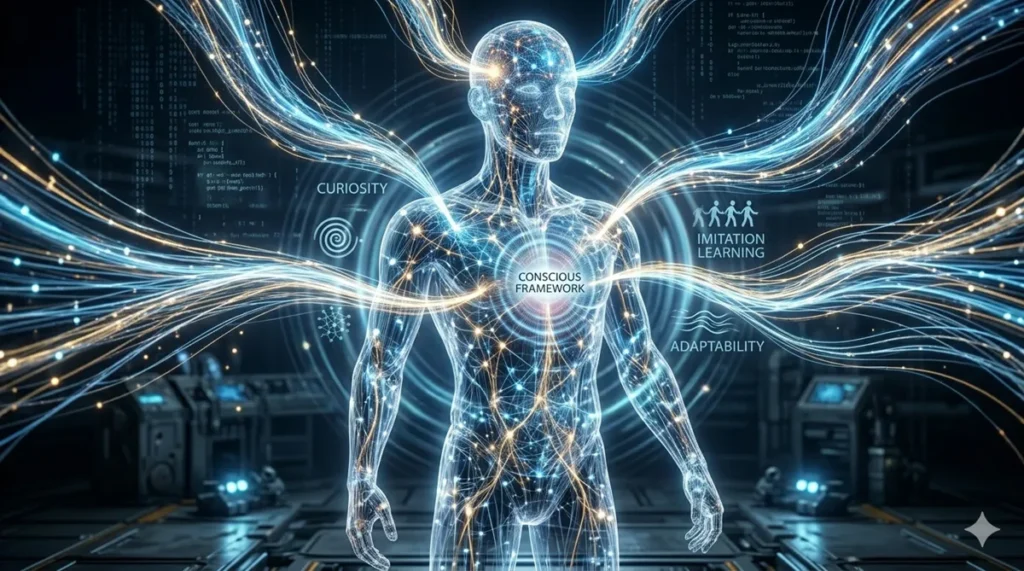
The foundation of Chappie’s “mind.” Even with zero knowledge, there is a sophisticated structure here that allows him to learn on his own.
Everyone dreams of having an AI partner like Chappie. But to be blunt: there is currently no commercial product that allows a user to “hand-rear” an AI from a blank slate.
Most of today’s AI products are shipped “pre-educated” for immediate convenience. While fields like On-device Learning and Edge AI are evolving to let AI learn a user’s habits or preferences, we are still far from Chappie’s world.
Currently, we can teach an AI a specific reaction, but teaching a “concept” from zero—like “This is a toy” or “This action is ‘bad'”—is a massive hurdle. Today’s AI arrives having already seen a “red apple” a million times. When you “train” it, you’re usually just doing Fine-tuning (e.g., “I prefer bananas over apples”).
To enjoy the actual process of education from scratch, you would need immense real-time computing power that home devices simply can’t handle yet.
The Brilliance of Design: Three “Default Settings” Supporting Ignorance
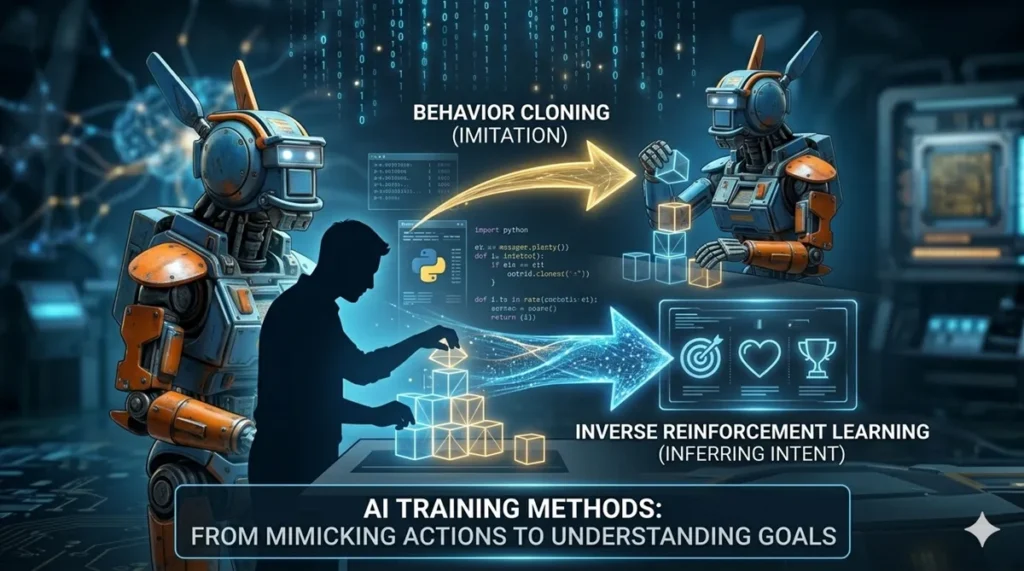
From imitation to understanding intention. Just as Chappie learned how to live from humans, AI also grows by observing human behavior.
For Chappie to act like a “clueless baby” while remaining capable of learning, he must have an incredibly sophisticated Learning Framework. In a real-world program, “zero knowledge” usually results in an error or silence.
I believe Chappie was built with these three advanced “initial configurations”:
Data Structure as a “Vessel of Consciousness” The most revolutionary part isn’t the control code, but the flexible data structure capable of forming a “personality” as experience flows in. This was the breakthrough that transcended the standard “Guard Dog” programs in the film.
Multimodal Grounding (Linking Body and Language) Chappie instantly links visual input with audio (speech). This proves he has a neural network that already “knows how to learn”—associating the sound “Apple” with a “red sphere” before the actual training begins.
Algorithms for Curiosity and Imitation His reactions—fear and mimicry—are advanced survival strategies. Mimicking Deon’s movements is a high-level technique called Imitation Learning. He doesn’t just copy; he acquires skills at an incredible speed through these programmed instincts.
Learning from Example: Behavior Cloning vs. Inverse Reinforcement Learning
How does an AI learn to “behave” like a human? In the field of Imitation Learning, there are two major approaches that mirror Chappie’s growth:
1. Behavior Cloning (BC)
- The Concept: The simplest method. It’s like a student taking verbatim notes from a teacher.
- How it Works: We provide a massive dataset of “states” (what the human sees) and “actions” (what the human does). It’s essentially Supervised Learning in Python.
- The Weakness: It lacks adaptability. If the AI encounters a situation it hasn’t “memorized” (like an unexpected obstacle), it often freezes or malfunctions.
2. Inverse Reinforcement Learning (IRL)
- The Concept: A smarter, more intuitive approach. The AI tries to “read the room.”
- How it Works: Instead of just copying movements, the AI observes a human and infers the underlying intent or “reward.” It figures out the rules of the game (e.g., “The goal is to reach the destination quickly without hitting walls”).
- The Benefit: Once the AI understands the “why,” it can navigate new, unseen situations on its own—much like how Chappie finds his own way to survive based on his goal of “not dying.”
| Feature | Behavior Cloning (BC) | Inverse Reinforcement Learning (IRL) |
| Simple Analogy | Rote Memorization | Understanding the Intent |
| Approach | Mimicking the exact action | Inferring the “Reward Function” |
| Adaptability | Weak in unseen situations | Strong and flexible |
Can AI Love the “Unknown”? Curiosity-driven Learning and Real-world Barriers
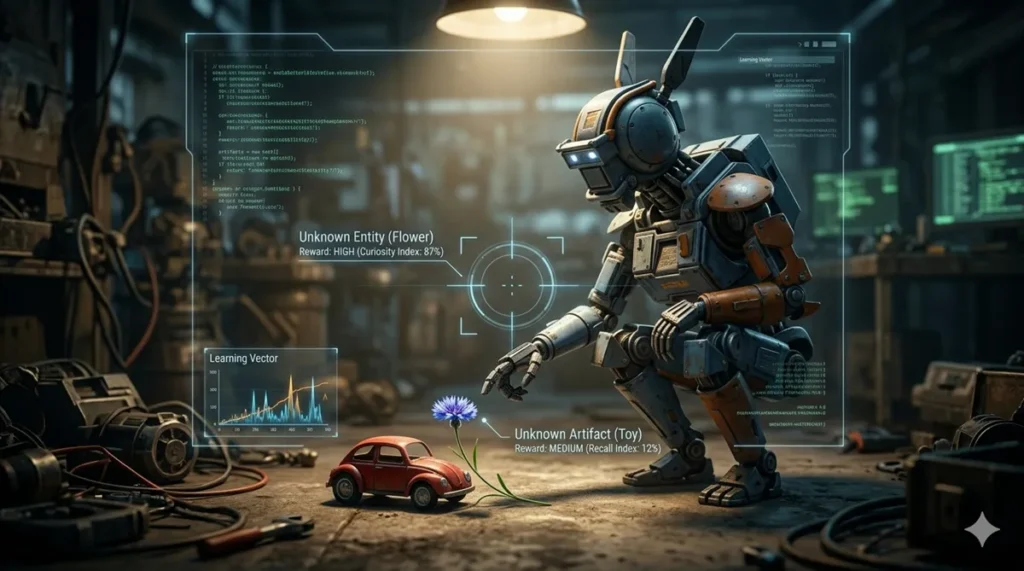
Give AI the wings of “curiosity.” By viewing encounters with the unknown as “highly rewarding,” it will begin to learn about the world on its own.
To give an AI “wings,” we use a method called Curiosity-driven Learning.
Using Python’s reinforcement learning libraries, we can program the AI to receive a “high reward” when it encounters data it hasn’t seen before or when its predictions fail. This forces the AI to explore the world autonomously, just like Chappie. It’s not about “teaching what to do,” but “teaching how to learn.”
The “Reality Gap”
However, there is a massive wall between digital curiosity and a real Chappie: Embodiment. Chappie feels pain, fears “death,” and processes real-time physical feedback. Today’s curiosity algorithms excel in digital simulations, but to develop a “soul” like Chappie’s, we need a deeper integration between AI and a physical body.
Who Will Raise the Chappie of the Future? Beyond the Intersection of Tech and Embodiment
The movie Chappie is far more than a sci-fi action flick. It poses the very questions that today’s AI engineers are grappling with: “What is intelligence?” and “What does it mean to educate?”
While today’s AI excels at following pre-defined “correct answers,” the frontier of research is steadily developing the tech for an AI to dive into the world, fail, mimic others, and eventually form its own unique personality—just like Chappie.
- Imitation Learning: The power to learn by watching others.
- Curiosity-driven Learning: The heart to explore the unknown without fear.
When these technologies perfectly align and are housed within a physical “Embodiment,” the Chappie we saw on screen will finally step into our reality.
When that day comes, whether the AI remains a mere “convenient tool” or grows into a lifelong “partner” may depend entirely on how we, the users, interact with it. Just as Chappie became a one-of-a-kind being through his encounters with Deon and the street gangs, the “personality” of future AI won’t be determined by the engineers who write the code—it will be shaped by “you,” the one who spends time by its side.


コメント