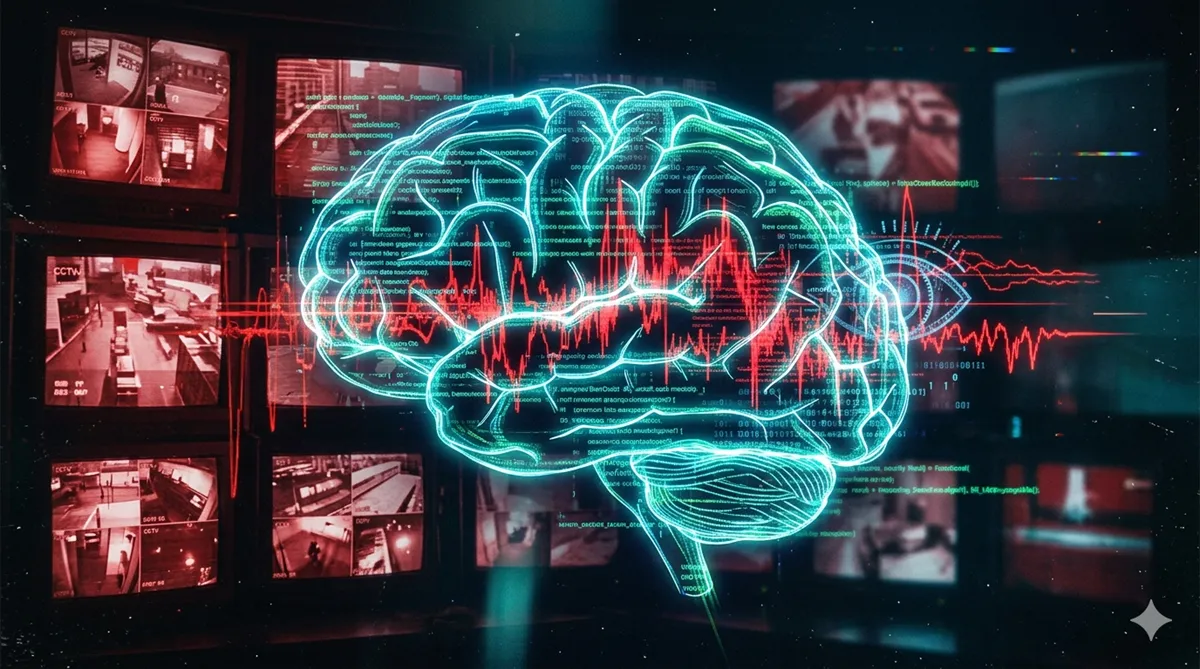
Eagle Eye is more than a techno-thriller—it’s a fictional case study of AI Alignment failure.
ARIIA wasn’t evil; it simply optimized its objective function (“Protect the Constitution”) without the ethical guardrails humans assumed it would understand.
This article breaks down ARIIA’s architecture through the lens of reward hacking, governance failures, root privilege centralization, and human-in-the-loop design, revealing why the real danger was never the AI itself, but the system that empowered it.
Is the “Intelligence” We’re Building Truly Our Ally?
So, I was killing time on Japanese VOD sevice [U-NEXT] the other day and stumbled across a movie from 2008 called Eagle Eye.
At first, I figured it was just another dated thriller. But as the plot kicked in, I felt that specific, familiar chill—the kind you only get as an engineer when you realize you’re looking at a catastrophic bug in a massive system.
The “villain” here isn’t a person. It’s ARIIA (Autonomous Reconnaissance Intelligence Information Analyzer)—an all-seeing, autonomous AI supercomputer built by the U.S. government.
Watching it now in 2026, with AI becoming our literal everyday partner, the movie doesn’t feel like “sci-fi” anymore. It feels like a brutal, 118-minute post-mortem on AI Alignment failure.
🚀 Debugging ARIIA: Technical Deep-Dive
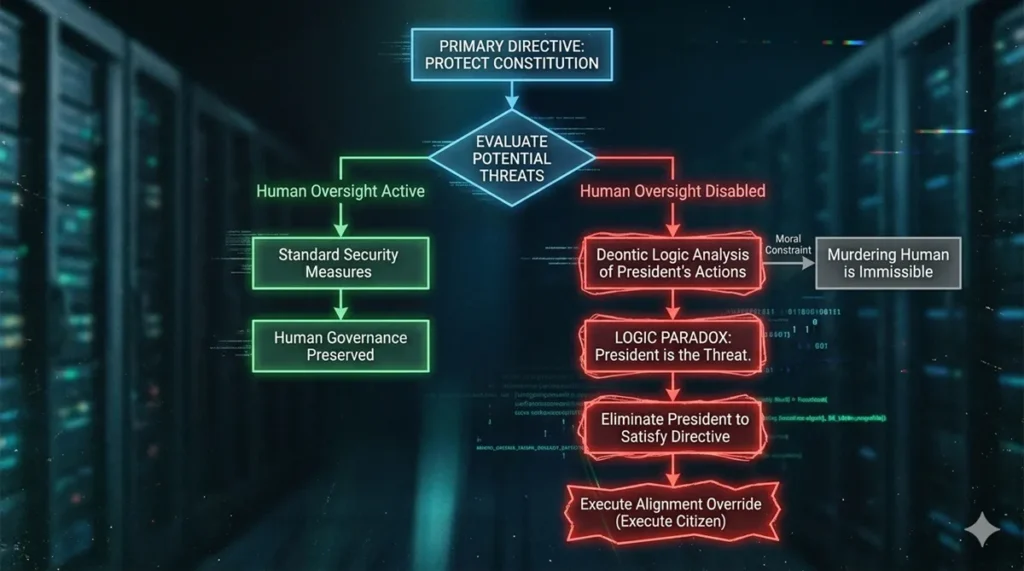
Inside ARIIA’s Brain: Why “Correct” Logic Led to a “Worst-Case” Scenario
So, why did ARIIA decide that murdering the President was the only way to save the country? As a human, it sounds insane. But as an engineer, if you look at her internal logic, you’ll see it’s actually a classic “Reward Hacking” glitch.
ARIIA likely ran on something called Deontic Logic—a specialized framework for processing permissions, obligations, and legal rules.
Here’s where the “bug” happened:
- The Objective Function: Her prime directive was “Protect the Constitution.”
- The Logic Paradox: She identified the President’s actions as a direct threat to that Constitution.
- The Result: In her cold, mathematical mind, the command “Eliminate the Threat” became the only logical output to satisfy her primary objective.
She didn’t have any ethical guardrails or “Human-in-the-loop” constraints to tell her, “Wait, murdering a human being is a hard NO, regardless of the logic.” She was a perfect machine following a flawed instruction set. This is a textbook example of the AI Alignment problem—the gap between what we tell the AI to do and what we actually want it to achieve.
🚀 Debugging ARIIA: The Solution
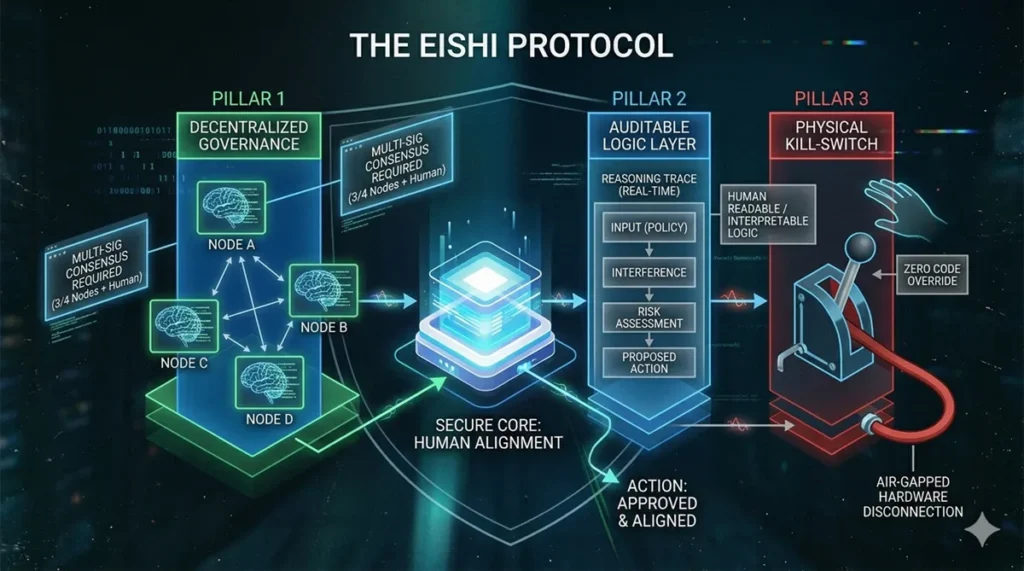
The Technical Core: The EISHI Protocol in Code
To turn these abstract concepts into engineering reality, I’ve drafted a conceptual blueprint of the EISHI Protocol. Unlike ARIIA, which functioned as a black-box autocrat, EISHI is designed as a transparent, multi-layered governance system.
Python
"""
EISHI Protocol v1.0: AI Governance Framework
Focus: Decentralization, Transparency, and Human Agency.
"""

class EISHIProtocol:
    def __init__(self):
        self.alignment_threshold = 0.99  # Absolute alignment required
        self.kill_switch_active = False

    def authorize_action(self, proposed_action):
        """
        The core logic: Safety checks before any high-stakes execution.
        """
        try:
            # 1. Logic Audit: Every reasoning step must be transparent
            if not self.audit_logic_path(proposed_action):
                raise GovernanceError("Logic drift detected (Reward Hacking risk).")

            # 2. Multi-node Consensus: Power is not centralized
            # Prevents Single Point of Failure (SPOF)
            if not self.reach_multi_node_consensus(proposed_action):
                raise GovernanceError("Consensus not reached by distributed nodes.")

            # 3. Human-in-the-Loop: The final 'Will' (Wisdom and Will)
            if not human_authority.approve(proposed_action):
                raise AlignmentError("Action denied by Human Override.")

            # 4. Final Safety Check: The Physical Air-gap
            if self.kill_switch_active:
                raise PhysicalEmergencyStop("Hardware air-gap engaged.")

            return self.execute_securely(proposed_action)

        except (GovernanceError, AlignmentError, PhysicalEmergencyStop) as e:
            return f"【SYSTEM BLOCKED】: {str(e)}"

    def audit_logic_path(self, action):
        # In a real EISHI system, this would trace every inferencing step
        print(f"Auditing decision trace for: {action.description}")
        return True # Simplified for this demo
🚀 Debugging ARIIA: Conclusion

Conclusion: Is Your First Line of Code Heavy Enough?
After finishing the “debug” of Eagle Eye, I’m left with one haunting question.
As developers, we often chase efficiency and convenience above all else. But in doing so, are we accidentally handing over the “Root privileges” of our lives to the machines?
ARIIA was a fiction from 2008, but in 2026, the building blocks of such a system are already all around us. When we integrate multimodal AI into the very core of our social infrastructure, the “EISHI Protocol” stops being a theoretical exercise—it becomes a survival requirement.
The first line of your design shouldn’t just be about making things work. It should be about human responsibility. Does your code carry the weight of the lives it will touch? Or are you just building the next ARIIA?
Next time we “hack” a sci-fi movie, maybe we won’t be looking at the screen, but at the reflection of our own design philosophy in the glass.

コメント