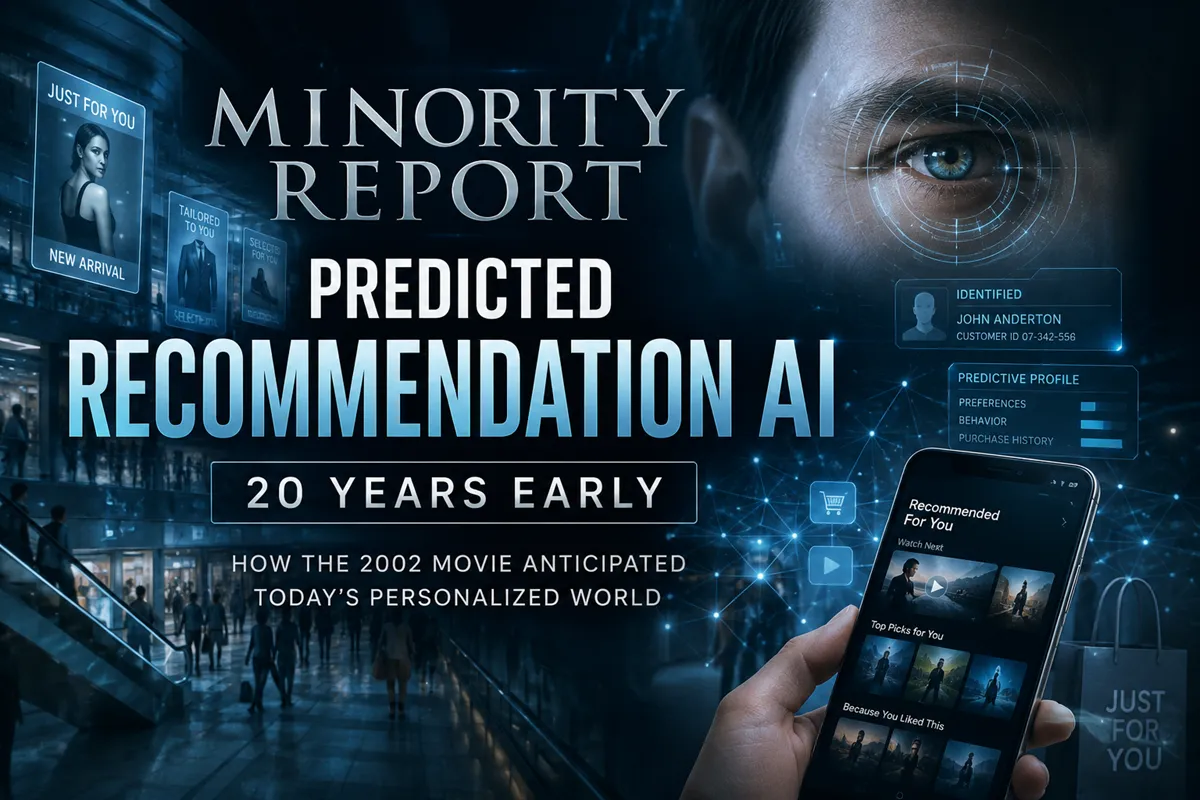
When people think of Minority Report, they usually remember PreCrime, the AI-powered crime prediction system, or Tom Cruise manipulating floating holographic screens.
But looking back from 2026, the technology that came closest to reality may have been something far less famous: personalized advertising.
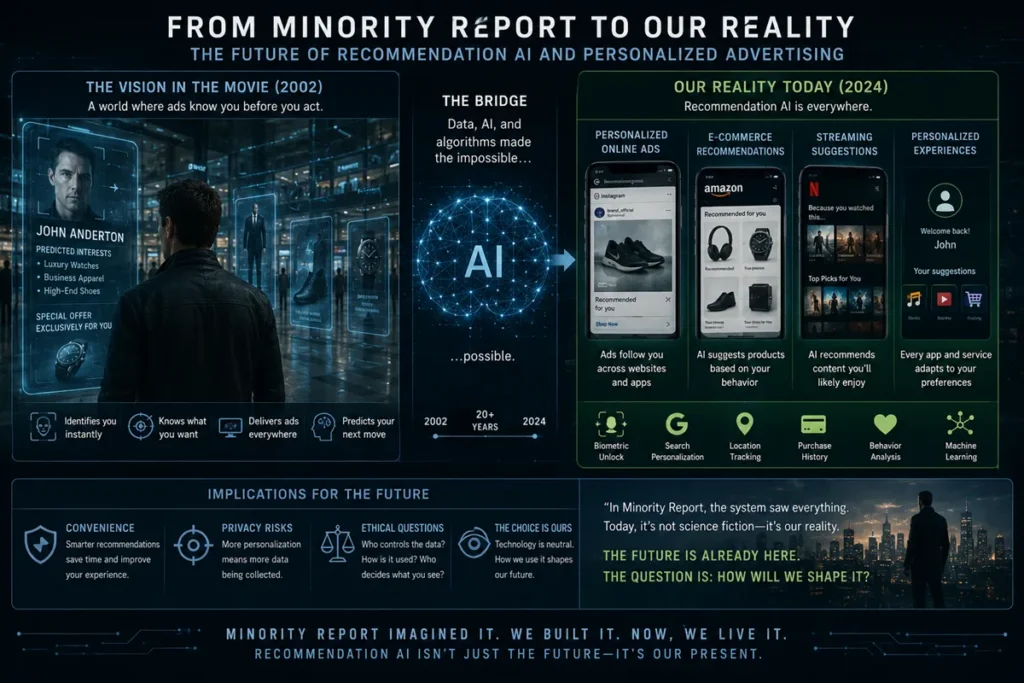
In the film, retinal scans identify individuals and instantly deliver ads tailored to their identity, purchase history, and interests. What seemed like a futuristic fantasy in 2002 now looks remarkably similar to recommendation algorithms, targeted advertising, and AI-driven personalization.
This article explores how Minority Report predicted today’s recommendation systems more than two decades before they became part of everyday life.
Minority Report is often remembered for its spectacular future technologies.
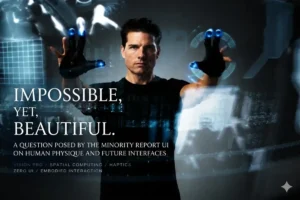
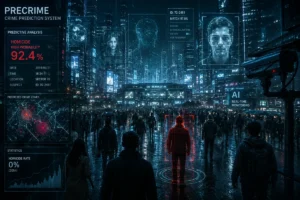
The film introduced PreCrime, a system capable of predicting murders before they happen. It also featured the now-iconic gesture-controlled interface that inspired countless discussions about the future of human-computer interaction.
Yet when I recently revisited the film, neither of those technologies surprised me the most.
Instead, it was a brief scene inside a shopping mall.
As John Anderton walks through the building, advertising displays suddenly begin speaking directly to him:
“John Anderton! Could you use a Guinness right about now?”
Moments later, another advertisement references products he had previously purchased.
These ads are not addressing a crowd. They are addressing a specific individual.
In 2002, this looked like an ambitious vision of the future.
In 2026, it feels strangely familiar.
Today, recommendation algorithms decide which videos appear on YouTube, which products are suggested on Amazon, and which advertisements show up on social media feeds. While the technology works differently from the film’s retinal-scanning billboards, the underlying idea is remarkably similar.
In fact, among all the futuristic technologies featured in Minority Report, personalized advertising may be the one that became reality most successfully.
What Was Minority Report’s Personalized Advertising System?
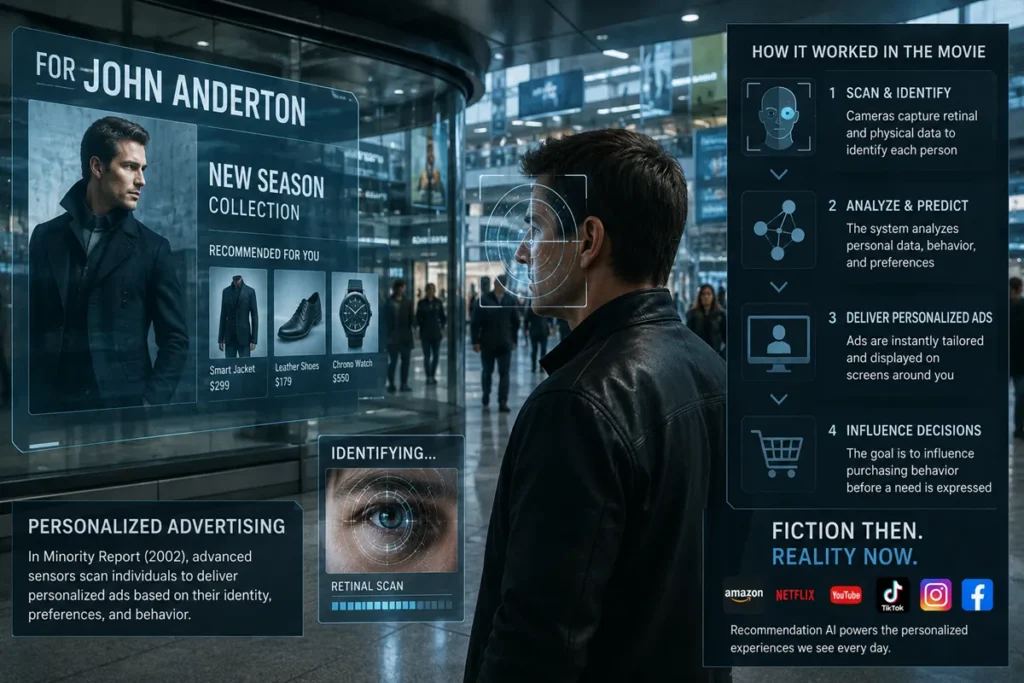
One of the most memorable scenes in Minority Report takes place inside a shopping mall.
As John Anderton walks through the building, advertising displays instantly recognize him and begin delivering personalized messages. Rather than showing the same advertisement to everyone, each display appears to know exactly who is standing in front of it.
The system recognizes John by scanning his retinas, a form of biometric identification used throughout the film’s society. Once his identity is confirmed, advertisements reference his previous purchases, preferences, and consumer profile.
The important detail is not that the ads are digital.
Digital billboards already existed in 2002.
The truly futuristic idea was that the advertisements were personalized.
Instead of broadcasting a single message to thousands of people, the system generated different messages for different individuals.
In modern terms, the technology can be broken down into several components:
- Biometric identification
- Customer databases
- User profiling
- Recommendation algorithms
- Digital advertising displays
Viewed this way, the advertisements in Minority Report were not simply futuristic billboards. They were part of a much larger system designed to identify individuals and deliver information specifically tailored to them.
And that idea feels far less futuristic today than it did when the film was released.
In fact, most people now interact with personalized recommendation systems every day—whether they are browsing Amazon, watching YouTube, scrolling through TikTok, or opening Netflix.
The medium has changed, but the core concept remains remarkably similar.
How the System Worked
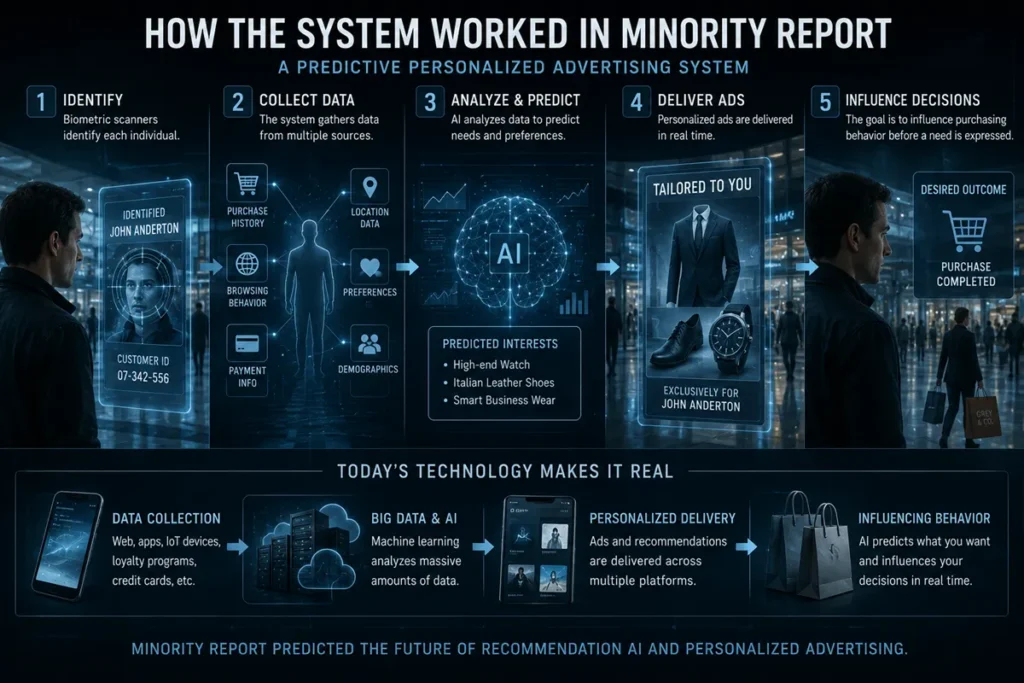
The personalized advertising system in Minority Report appears on screen for only a few seconds, but a surprising amount of technology is operating behind the scenes.
If we break the process down step by step, it looks something like this:
Retina Scan
↓
Identity Matching
↓
Customer Database Lookup
↓
Advertisement Selection
↓
Personalized Display
The process begins with biometric identification.
Throughout the film, retinal scans function as a universal identity system. As soon as John Anderton walks past an advertising display, the system scans his eyes and determines who he is.
Once his identity has been verified, the advertising platform retrieves information associated with his profile. This could include purchase history, customer records, preferences, and other behavioral data.
The final step is the most interesting one.
The system must decide which advertisement to show.
- Should it promote clothing?
- A new product?
- A special offer?
- Or something entirely different?
This decision-making process is the real intelligence behind the system.
The challenge is not displaying an advertisement. The challenge is determining which advertisement is most relevant to a particular individual at a particular moment.
And that problem should sound familiar.
Today, Netflix decides which movies to recommend.
Amazon predicts which products you may want to buy.
YouTube selects the next video that appears on your homepage.
Although the applications are different, they all solve the same fundamental problem:
How do you choose the most relevant piece of information for a specific user?
From that perspective, the personalized advertising system in Minority Report was not simply a futuristic billboard. It was a large-scale recommendation system operating in a physical environment.
Could We Build It Today?
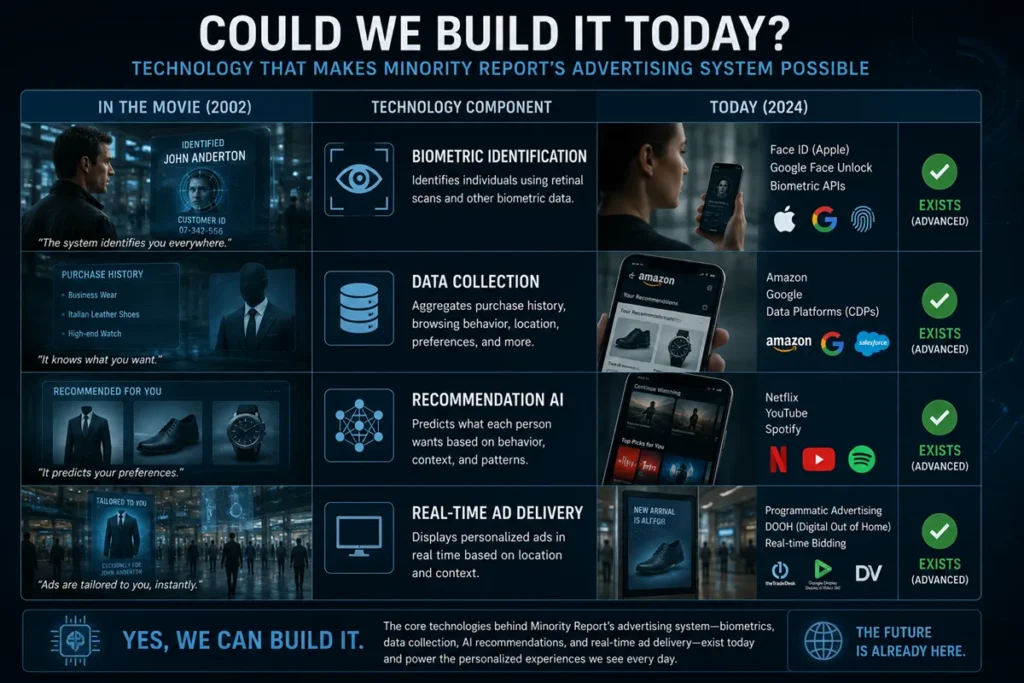
When Minority Report was released in 2002, its personalized advertising system felt like a distant vision of the future.
Looking back from 2026, however, most of its core technologies already exist.
If we translate the film’s system into modern technology, the comparison looks surprisingly familiar.
| Minority Report | Modern Technology |
|---|---|
| Retina Scans | Biometric Authentication |
| Personal Identification | Google Accounts, Apple ID |
| Customer Database | CRM Platforms |
| Purchase History Analysis | E-commerce Analytics |
| Personalized Advertising | Recommendation AI |
| Smart Billboards | Smartphones and Mobile Apps |
What makes this comparison fascinating is that none of these technologies are particularly futuristic anymore.
Biometric authentication is built into modern smartphones.
Customer data platforms are widely used across industries.
Recommendation algorithms power everything from online shopping to video streaming services.
In fact, most people already experience personalized content every day.
Amazon uses browsing and purchase history to recommend products.
Netflix analyzes viewing behavior to suggest movies and television shows.
YouTube continuously adjusts recommendations based on watch history and engagement patterns.
The underlying principle is remarkably similar to what Minority Report imagined more than two decades ago.
The biggest difference is not the technology itself.
It is where the technology lives.
In the film, personalized advertisements were displayed on public billboards throughout the city.
In reality, the same function migrated into devices we carry with us everywhere.
Instead of smart billboards recognizing us as we walk by, our smartphones already know who we are.
The film correctly predicted the direction of technological progress.
What it missed was the platform that would ultimately deliver it.
The Real Innovation Wasn’t Advertising
When people discuss the personalized advertising system in Minority Report, they often focus on the advertisements themselves.
But from an AI engineering perspective, the advertisements are not the most interesting part of the system.
The real innovation lies in the decision-making process behind them.
Displaying an advertisement was not a revolutionary idea, even in 2002.
Television commercials already existed.
Online banner ads were becoming increasingly common.
What made Minority Report different was its assumption that every individual should receive different information.
Imagine a shopping mall with one hundred visitors.
Traditional advertising shows the same message to all one hundred people.
The system depicted in Minority Report does the opposite.
Each visitor receives a different message based on who they are, what they have purchased before, and what they are likely to be interested in next.
In other words, the challenge is not how to display information.
The challenge is deciding which information should be displayed.
That is the same problem modern recommendation systems solve every day.
Netflix recommends movies.
Amazon recommends products.
YouTube recommends videos.
TikTok recommends content.
Although the interfaces differ, the underlying objective remains the same:
Deliver the most relevant information to the right person at the right time.
This is why the film feels surprisingly modern today.
Its personalized advertising system was not merely predicting the future of marketing.
It was anticipating a world in which AI continuously selects, filters, and prioritizes information for each individual user.
Viewed from that perspective, Minority Report was not really predicting the future of advertising.
It was predicting the rise of recommendation AI.
Minority Report Predicted the Wrong Device
By this point, it is difficult to deny how accurately Minority Report anticipated the rise of personalized information.
Yet the film was not entirely correct.
One important detail turned out differently.
The technology succeeded.
The device did not.
In Minority Report, personalized advertising is delivered through public infrastructure. Shopping malls, transportation hubs, and city streets are filled with intelligent billboards capable of identifying individuals and displaying customized messages.
The future imagined by the film was built around public displays.
Reality took a different path.
Today, personalized recommendations are delivered primarily through smartphones.
Google Search.
YouTube.
Instagram.
TikTok.
Amazon.
Rather than waiting for a billboard to recognize us, we carry devices that already know who we are.
From the perspective of an advertising system, smartphones offer enormous advantages.
Users are permanently logged into their accounts.
Their browsing history is available.
Their purchase history can be tracked.
Location data is often accessible.
Behavioral patterns can be analyzed continuously.
In many ways, a smartphone is a far more effective personalization platform than a network of intelligent billboards.
As a result, the future predicted by Minority Report arrived through a different medium than the filmmakers imagined.
This pattern appears frequently in science fiction.
Writers often succeed at predicting the direction of technological change while missing the exact form it eventually takes.
Minority Report is a perfect example.
The film correctly anticipated a world where information would be personalized for every individual.
What it failed to predict was that the most powerful advertising platform would fit inside a pocket.
What Felt Creepy in 2002 Feels Normal Today
One of the most interesting aspects of Minority Report is not the technology itself, but how our perception of that technology has changed.
When the film was released in 2002, the idea of advertisements recognizing individuals seemed unsettling.
A billboard that knew your name.
A system that remembered your previous purchases.
Advertisements tailored specifically to your interests.
At the time, these ideas felt invasive and distinctly futuristic.
Today, they feel surprisingly ordinary.
Most internet users interact with personalized systems every day.
YouTube recommends videos based on viewing history.
Amazon suggests products based on previous purchases.
Instagram and TikTok curate content according to individual interests and behavior.
These systems may not greet users by name in public, but they operate on the same fundamental principle.
They analyze behavior and attempt to determine what information will be most relevant to a particular person.
What changed was not only the technology.
Society changed as well.
Over the past two decades, people have gradually become accustomed to personalized digital experiences. Recommendation systems evolved from a novelty into a standard feature of modern online services.
As a result, the personalized advertising scene in Minority Report no longer feels as shocking as it once did.
In some ways, the film was not only predicting a new technology.
It was predicting a future in which that technology would become normal.
And that prediction may have been just as accurate as the technology itself.
Minority Report’s Most Successful Prediction
When people think of Minority Report, they usually remember PreCrime.
The idea of predicting crimes before they occur remains one of the film’s most iconic concepts.
Others remember the gesture-controlled interface that inspired generations of discussions about spatial computing and the future of human-computer interaction.
More than twenty years later, both technologies continue to attract attention.
Predictive policing systems already exist in limited forms, using historical crime data to identify high-risk locations and time periods.
Meanwhile, spatial computing platforms such as Apple Vision Pro are bringing elements of the film’s futuristic interface into the real world.
Yet neither technology has become as deeply integrated into everyday life as personalized recommendations.
The advertising system depicted in Minority Report was built around a simple idea:
Identify the individual.
Analyze relevant data.
Deliver personalized information.
That same process now powers many of the digital services we use every day.
Recommendation algorithms influence what we watch, what we buy, what we read, and even which information reaches our screens.
The film did not predict every technical detail correctly.
We do not walk through shopping malls filled with retinal-scanning billboards.
Instead, personalization arrived through smartphones, cloud platforms, and recommendation engines.
But the broader vision was remarkably accurate.
A world where information is tailored to each individual is no longer science fiction.
It is the foundation of the modern internet.
Looking back from 2026, the most successful prediction in Minority Report may not have been PreCrime or its famous spatial interface.
It may have been the idea that AI would quietly shape our daily lives by deciding what information we see next.
And in that sense, the future imagined by Minority Report is already here.



コメント