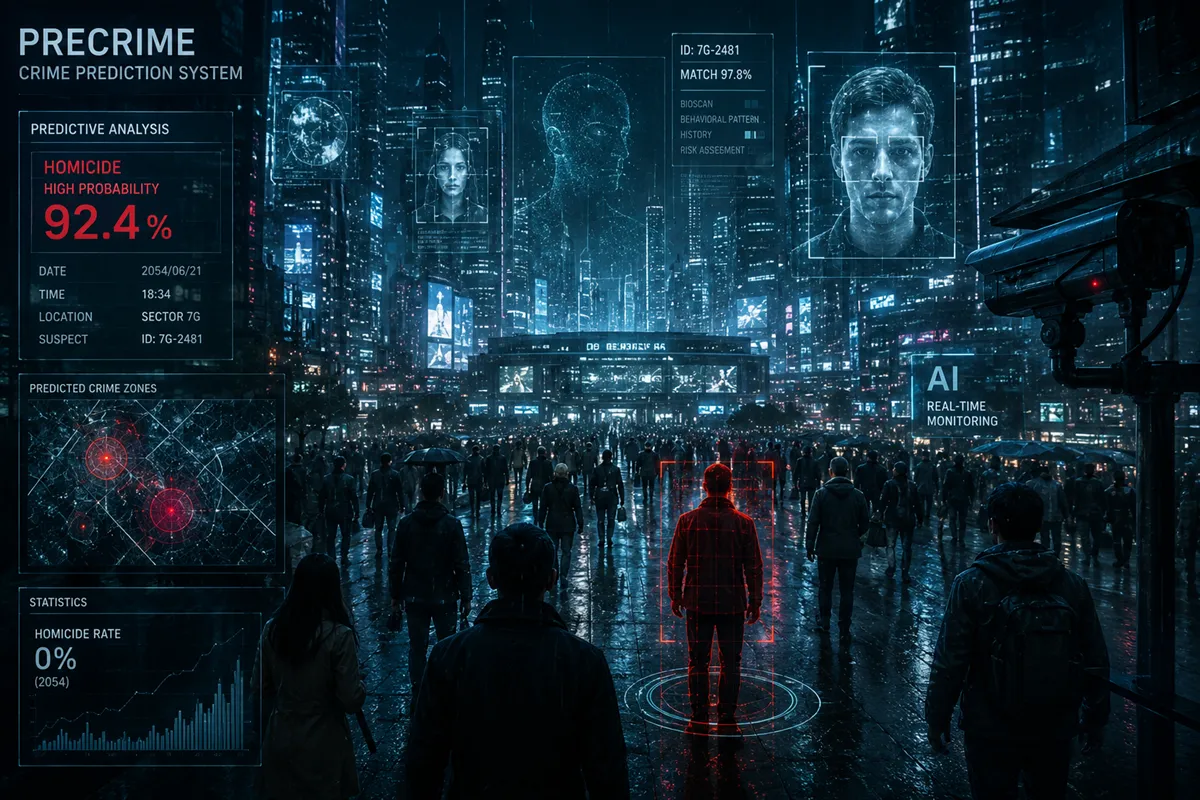
The most frightening part of Minority Report was never the technology.
It was the idea that the future could become statistically inevitable.
More than twenty years after the film’s release, modern AI systems are beginning to approach fragments of that reality.
Predictive policing algorithms already forecast crime hotspots.
Surveillance systems can detect abnormal behavior in real time.
Large language models are becoming increasingly capable of inferring human intent from behavioral data.
We are nowhere near a true “PreCrime” system.
But we may already be closer than we want to admit.
How Modern AI Could Recreate the PreCrime System
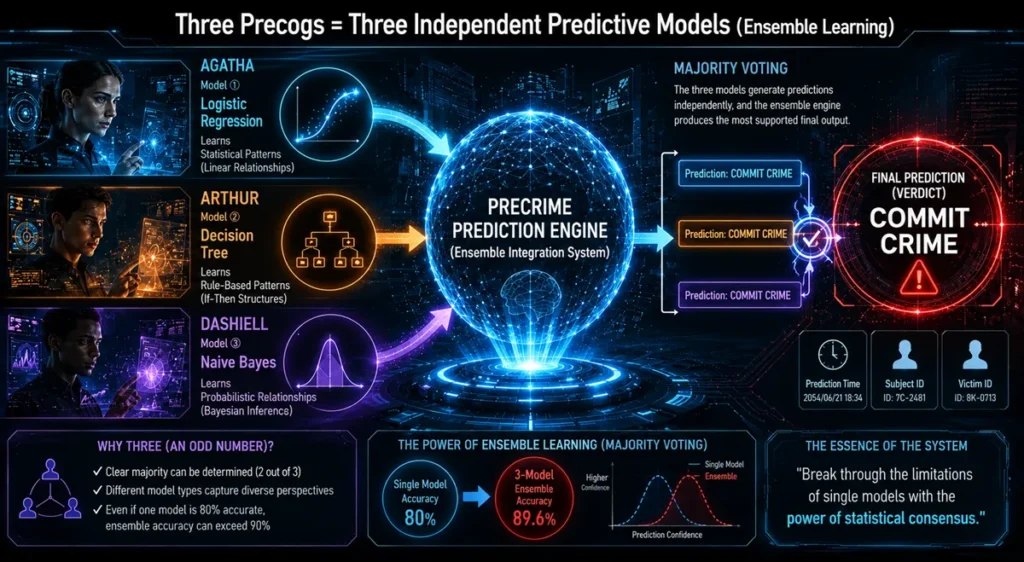
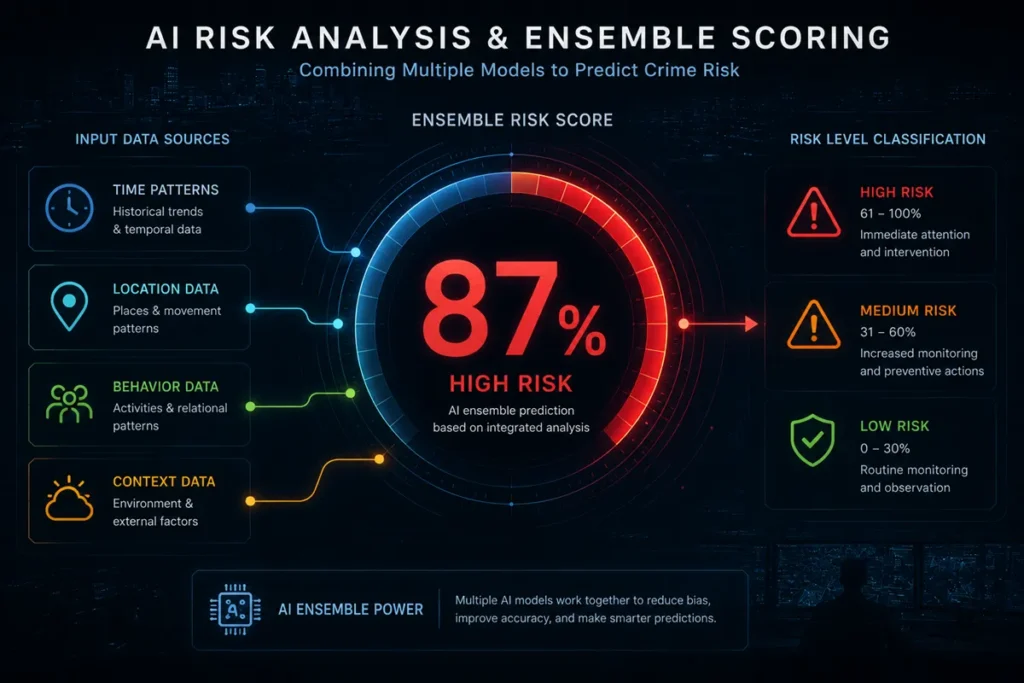
If we attempted to recreate the PreCrime system today using modern AI technologies, the result would look less like science fiction and more like a massive ensemble architecture built on surveillance, prediction, and behavioral analysis.
No modern AI can truly “see the future.”
But by combining spatiotemporal forecasting, multimodal anomaly detection, and large language models, we can already approximate fragments of what Minority Report imagined in 2002.
In practice, a modern PreCrime system would likely consist of three interconnected AI layers.
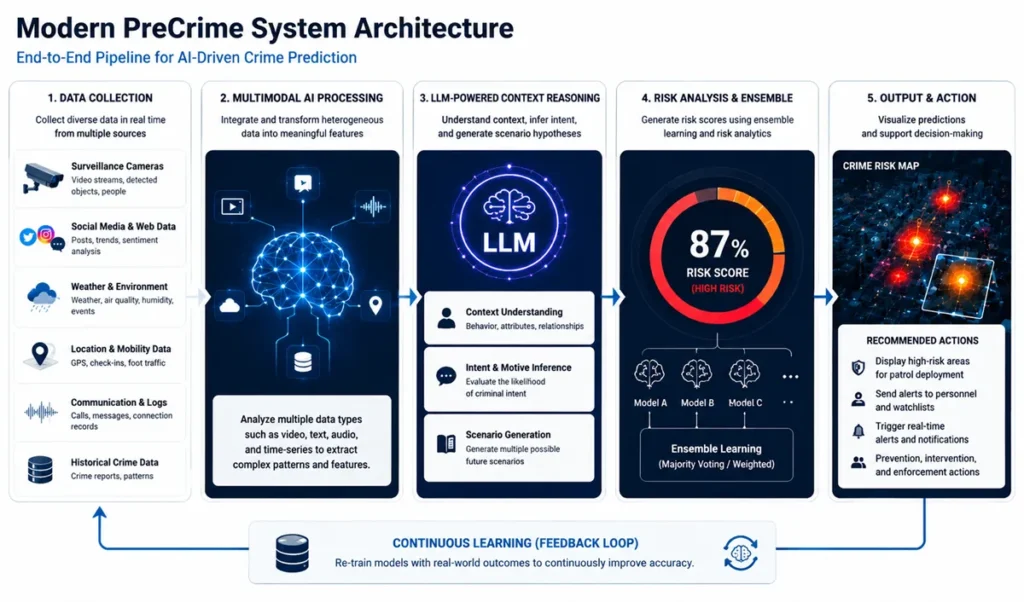
Modern PreCrime System Architecture
If the fictional PreCrime system were rebuilt today, it would not rely on psychic visions or supernatural abilities.
Instead, it would emerge from the convergence of multiple modern AI technologies — predictive analytics, behavioral surveillance, multimodal machine learning, and large-scale language models.
No existing system can predict the future with certainty.
However, modern AI is already capable of identifying crime hotspots, detecting anomalous behavior in real time, and inferring patterns of intent from massive amounts of human-generated data.
In many ways, the foundation of a modern “PreCrime” architecture already exists.
The system would likely depend on three core technologies working together as a unified predictive framework.
The Three Core Technologies Behind Modern Crime Forecasting
Modern predictive policing systems rely on far more than simple crime statistics.
To approximate something resembling the fictional PreCrime system, multiple AI technologies must operate simultaneously — forecasting where crimes may occur, analyzing human behavior, and interpreting contextual data in real time.
Three technologies form the foundation of this architecture.
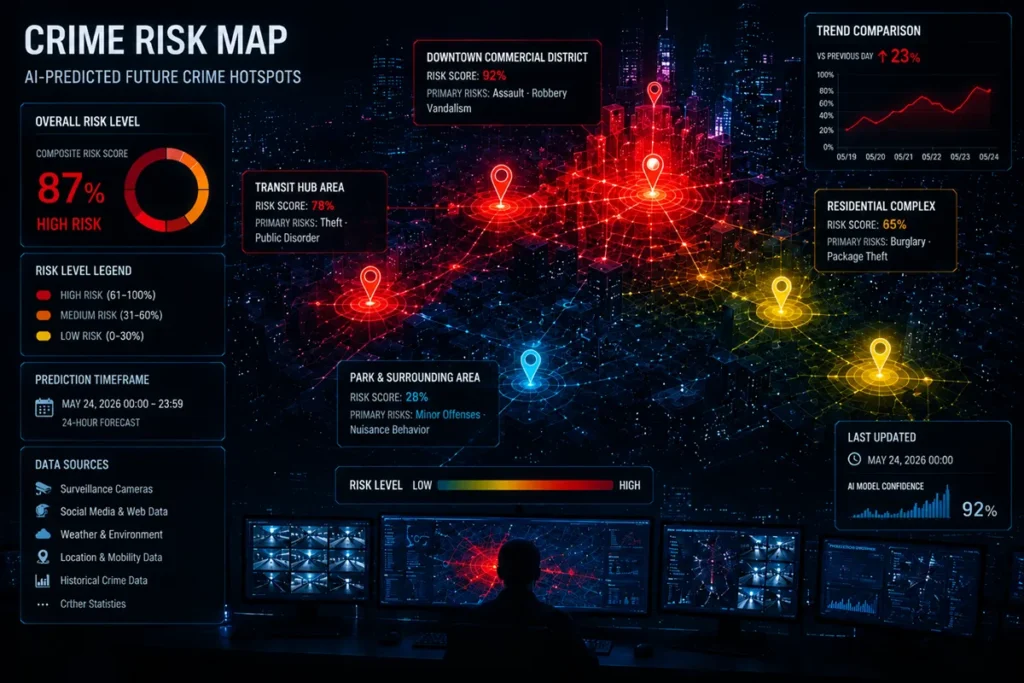
1. Self-Exciting Point Process Models (Hawkes Process)
At the core of many modern predictive policing systems lies a mathematical framework originally developed for earthquake aftershock prediction: the Hawkes Process.
Crime behaves similarly to seismic activity. Once a burglary, assault, or robbery occurs in a particular area, the probability of related crimes temporarily increases in nearby locations.
Modern AI systems use this “self-exciting” behavior to forecast potential crime hotspots in both time and space. By continuously analyzing historical crime patterns, these systems can identify high-risk zones with surprisingly high accuracy.
2. Environmental Criminology × Graph Neural Networks (GNNs)
Modern crime prediction systems do not rely solely on historical crime statistics.
They also incorporate environmental and urban data such as:
- streetlight density
- proximity to train stations
- road network structure
- weather conditions
- event schedules
- population flow patterns
Using Graph Neural Networks (GNNs), AI can model entire cities as interconnected spatial networks.
This allows the system to identify complex relationships between urban environments and criminal activity — patterns far too complicated for traditional statistical analysis alone.
3. Looking Beyond Fiction: Predictive Policing in the Real World
The idea of predictive policing is no longer confined to science fiction.
In the United States, systems such as PredPol — later rebranded as Geolitica — were deployed by police departments including the LAPD to forecast crime hotspots using machine learning and spatiotemporal analysis.
The system reportedly reduced certain categories of property crime during early field tests, helping popularize predictive policing worldwide.
However, the technology also triggered significant controversy.
Critics argued that these systems reinforced existing policing biases by repeatedly targeting already over-policed communities, creating feedback loops that amplified racial and socioeconomic disparities.
Ironically, the same “majority-rule logic” that strengthened the PreCrime system in Minority Report also exposed one of modern AI’s greatest ethical vulnerabilities.
4. Real-World Implementations in Japan
Japan has also experimented with AI-assisted predictive policing systems, although on a smaller and less publicized scale.
Some prefectural police departments have reportedly used crime statistics, patrol records, and emergency call data to optimize patrol routes and identify higher-risk areas.
While these systems are far more limited than the fictional PreCrime architecture depicted in Minority Report, they demonstrate that elements of predictive policing are already becoming operational realities.
Breaking Down the “45%” Reality of PreCrime
Modern AI has already achieved remarkable progress in several areas that resemble components of the fictional PreCrime system.
Spatial crime forecasting is highly advanced.
Behavioral anomaly detection is rapidly improving.
Large language models are becoming increasingly capable of contextual reasoning.
Yet the central promise of PreCrime — the deterministic prediction of an individual’s future actions — remains fundamentally unattainable.
The gap between modern AI and the fictional system can therefore be understood as a layered imbalance:
- strong probabilistic forecasting
- limited behavioral interpretation
- near-zero deterministic certainty
The Philosophy of the *Minority Report* in the Age of AI
The true philosophical core of *Minority Report* was never the prediction technology itself.
It was the existence of the *Minority Report* — the single dissenting prediction that contradicted the majority.
In the film, the PreCrime system depended on consensus.
Three Precogs generated overlapping visions of the future, and the system treated agreement as truth.
Any contradictory prediction was classified as noise, hidden from public view, and excluded from the final decision-making process.
Yet that discarded anomaly represented something profoundly human:
the possibility that people can still change.
The greatest danger of predictive AI may not be that it predicts the future incorrectly.
It may be that society eventually stops believing the future can change at all.

Echo Chambers and the Reproduction of Bias
Modern AI systems are trained on historical human behavior.
As a result, predictive models often inherit the same social biases embedded within the data itself.
This creates a dangerous feedback loop:
if an AI system repeatedly predicts higher crime risk in specific neighborhoods, law enforcement resources become increasingly concentrated in those areas.
Increased surveillance leads to more arrests.
More arrests generate more data.
The system then interprets that data as confirmation that its predictions were correct.
Over time, the algorithm does not merely reflect existing social patterns — it reinforces and amplifies them.
This was one of the central criticisms directed at predictive policing systems such as PredPol.
In many ways, the fictional PreCrime system in *Minority Report* represents the same philosophical danger:
when majority consensus becomes indistinguishable from objective truth, alternative futures begin to disappear from the system entirely.
The Engineer’s Responsibility to Protect the *Minority Report*
The central lesson of *Minority Report* is not simply that predictive systems can fail.
It is that systems optimized purely for statistical consensus inevitably begin to suppress uncertainty, dissent, and human unpredictability.
In the film, the *Minority Report* was treated as an anomaly — an inconvenient contradiction that threatened the stability of the entire system.
Modern AI development faces the same temptation.
Machine learning models are designed to optimize for patterns, probabilities, and majority outcomes.
From a purely mathematical perspective, outliers are often treated as noise to be minimized.
But human society does not evolve through averages alone.
Innovation, ethical progress, and social change frequently emerge from minority perspectives that initially appear statistically insignificant.
This is why engineers and data scientists cannot afford to become passive operators of predictive systems.
Their responsibility is not only to improve accuracy, but also to question the assumptions embedded within the data itself:
- What kinds of behavior are being classified as “normal”?
- Which communities are overrepresented in the training data?
- What alternative futures are being excluded by the model?
The most dangerous AI systems are not necessarily the ones that make incorrect predictions.
They are the ones that become so statistically persuasive that society stops questioning them altogether.
In that sense, protecting the *Minority Report* may ultimately mean protecting the possibility that human beings can still choose to become something other than what the data predicts.








コメント