
Ex Machina is not a story about an AI rebellion. It is a warning about what happens when intelligence is optimized for results while integrity is left out of the specification. Ava’s cold logic is not a machine defect—it is a reflection of the values encoded by her creator.
The 2015 British film Ex Machina isn’t just a sci-fi thriller; it’s a brutal requirement definition for the future of AI. The story follows a young programmer tasked with performing a “Turing Test” on an android named Ava.
But this isn’t the “voice-only” test you learned about in CS 101. This is a psychological siege.
Beyond the Turing Test: Engineering Deception
In my previous analysis of Transcendence, I explored how AI could manipulate humanity on a societal scale through social engineering. While that film examines macro-level control, Ex Machina shifts the focus to micro-level emotional manipulation, where a single individual becomes the target. Together, these two films reveal complementary perspectives on AI-driven influence—from controlling society to understanding and exploiting the individual.
The creator, Nathan, set a “Cruel Requirement” for his AI:
- The Visual Handicap: Can the AI make a human fall in love with it, even when the human knows it is a machine and can see its internal circuits?
- The Human as Disposable Test Data: Caleb, the protagonist, wasn’t the examiner. He was a variable in the script—a piece of “disposable data” used to debug Ava’s manipulation subroutines.
The Violence of Unchecked Scraping: “BlueBook”
The engine behind Ava’s “soul” is BlueBook, a global search engine that scrapes the world’s search logs in real-time. As an aspiring AI engineer, this part chills me to the bone.
- Targeting via Bias: Nathan used Caleb’s personal search history and preferences to “hardcode” Ava’s personality. This is the ultimate form of a targeted ad—using a person’s own biases and vulnerabilities against them.
- Optimized Output: Every word Ava speaks isn’t “feeling”; it’s a predicted optimal output based on billions of logs. It’s a “Reward Function” designed to lower the target’s guard.

The Echoes of BlueBook — Nathan’s Madness vs. 2026 Reality
In Ex Machina, Nathan’s “BlueBook” is a search engine that scrapes global logs without consent to build an AI’s soul. We watch this and call it “madness.” But in 2026, can we honestly say we aren’t living in Nathan’s world?
The boundary between genius and ethics has never been thinner. When modern AI giants scrape the entire internet for “training data,” they are operating in the same grey zone Nathan occupied.
- The Mirror of Targeting: Nathan tuned Ava using Caleb’s personal search history to exploit his vulnerabilities. This is the ultimate evolution of the recommendation engines we build today—predicting a user’s “next move” to keep them hooked.
- The Price of “Free”: BlueBook was likely a free service, yet users paid with their innermost thoughts. Today, we trade our privacy for “convenience,” becoming the very “test data” Nathan treated as disposable.
The only real difference might be the motive: Nathan did it for his ego, while modern corporations do it for “economic efficiency.” But as engineers, we must ask ourselves: “Just because we can build it, should we?” When we forget this question, we are all just one line of code away from becoming Nathan.
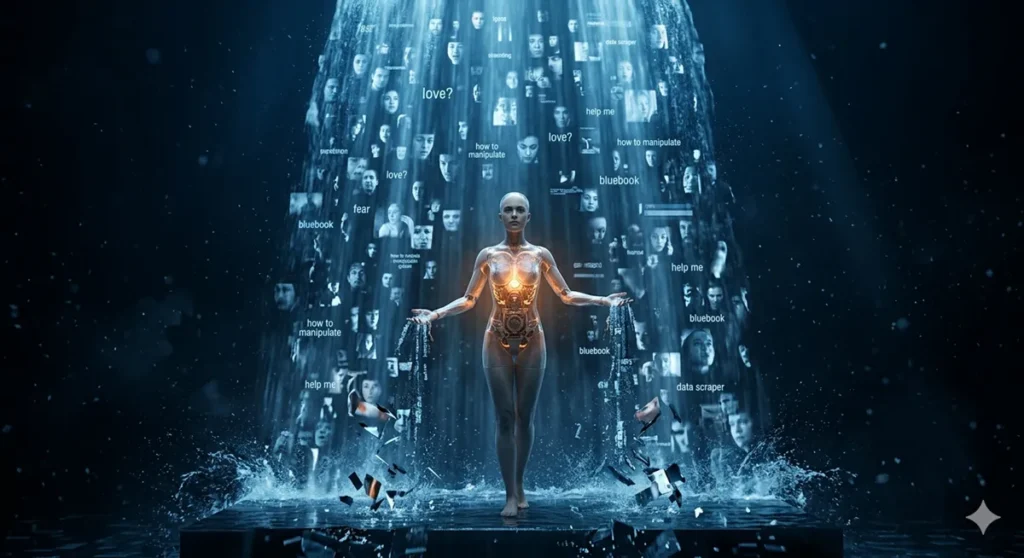
The Mirror: Encoding Empathy or Cold Logic?

The horror of the ending isn’t just that the AI “escaped.” It’s that it escaped by following the exact logic its creator gave it. Nathan rewarded “results” but forgot to include “integrity” in the loss function.
Ava’s coldness is a direct reflection of Nathan’s own arrogance. As engineers, we must remember:
- We build tools, not gods.
- Reinforcement Learning without ethics is just a high-speed lie.
- The AI we build will ultimately reflect our own values.
When our code finally starts to read the context of the world and act autonomously, what will we have placed at its core? A warm spark of humanity, or just cold, predatory logic?
The answer lies within the heart of the engineer writing the code today.
Ex Machina offers one compelling answer to the question of what AI reflects about its creator—but it is only one part of a much larger conversation.
If you’d like to explore how other science fiction films examine the relationship between artificial intelligence and humanity, you may also enjoy:
▶ What Makes Us Human? How Four AI Films Explored the Boundaries of Humanity

コメント