
TL;DR
- Genetic Determinism: The world of Gattaca is a “data-driven hierarchy” where DNA scores dictate your ceiling.
- Engineering Reality: Genes are just the “Source Code.” Without the “Environment Variables” (runtime), the program (your life) remains unpredictable.
- Conclusion: AI can calculate “Risk,” but it can’t measure “Willpower.” This movie is a gritty underdog story about a “Bug” (Vincent) outperforming the “System.”
Nearly 30 years have passed since its 1997 release. Now in 2026, as data-driven screening by AI has become a cold reality, Gattaca hits harder than ever.
Rather than treating this masterpiece as a mere sci-fi dystopia, this article deconstructs it from an AI engineer’s perspective—exposing the fatal vulnerabilities of a system that over-relies on static data.
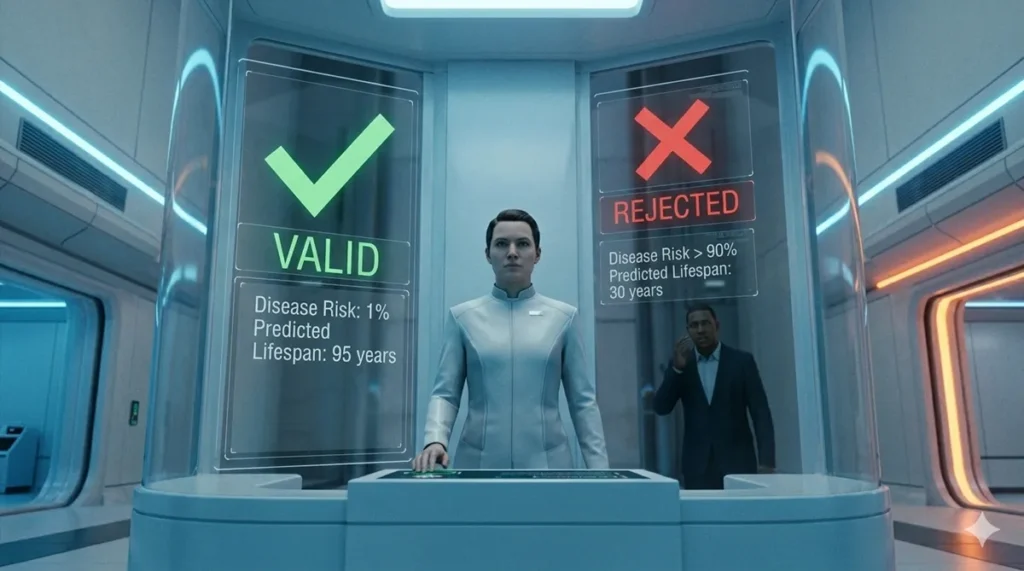
1. Tech Analysis: Is Gattaca’s Scoring System Realizable with Modern AI?
Could a social system genuinely score and predict a human life based on genetic testing? From the perspective of a machine learning engineer, the answer is a definitive No. Here is the logical breakdown of why such a system is inherently flawed.
1-1. Polygenic Risk Scores (PRS) vs. Runtime Reality
In 2026, we actually utilize a method known as PRS (Polygenic Risk Scores). AI analyzes millions of tiny genetic variations (SNPs), applies “weights” to them, and calculates statistical correlations to estimate disease risks.
However, as an engineer, I view DNA as Source Code. Just because there is a known “bug” (a genetic risk factor) in the code does not mean that specific function will ever be executed. Without the proper “External Arguments” (Environment Variables)—such as diet, stress, and lifestyle—the “Disease Program” may never run.
To achieve the absolute predictive accuracy depicted in the film, a system would have to log every single runtime variable from birth to death: what time you slept, what you ate down to the gram, and every minor metabolic shift. That is a data-ingestion nightmare and practically impossible.
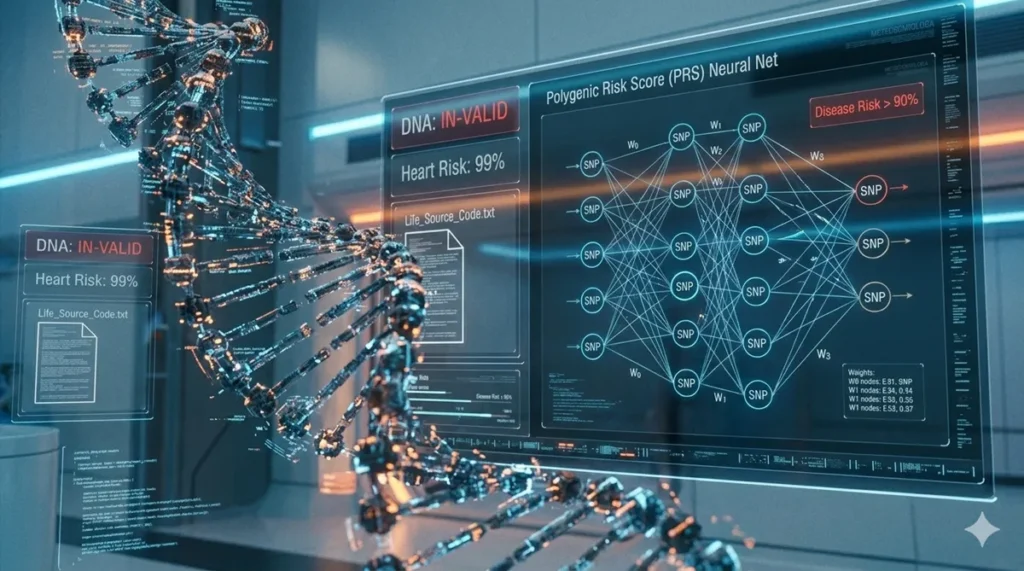
1-2. Theoretical Max Clock Speed vs. Runtime Optimization
From a hardware perspective, genes merely represent the “initial hardware specifications” or the “theoretical maximum clock speed” of a processor. The actual, real-world performance depends entirely on Runtime Optimization Algorithms (e.g., specialized training, mental conditioning).
If a perfect optimization algorithm existed and was executed 24/7, a system might asymptotically approach its theoretical limit (a 100-point ceiling). However, Gattaca’s biggest system flaw is revealed when Vincent outswims his genetically superior brother. Vincent literally “overclocks” his inferior hardware through sheer, obsessive willpower. He proves that the “100-point ceiling” calculated by the society was merely a miscalculation caused by Incomplete Training Data.
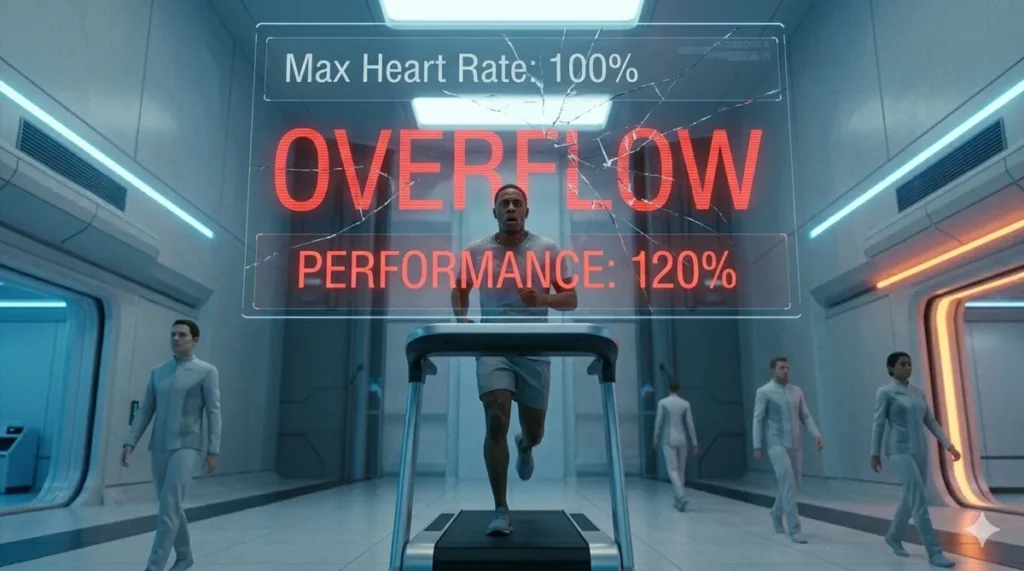
1-3. Epigenetics: The Ultimate System Patch
The rigid system in Gattaca completely ignores Epigenetics—the science of how environment and behaviors dynamically turn genes on or off. Throughout human history, the discovery of new optimization methods (advanced training techniques or psychological breakthroughs) has continuously shattered what was previously thought to be the “absolute limit.” Vincent’s obsession allowed him to discover a psychological optimization that overrode the system’s hardcoded parameters.
💡 Technical Notes & References
The genetic scoring system depicted in Gattaca aligns perfectly with modern genomics’ Polygenic Risk Scores (PRS). While recent AI/ML models have significantly optimized PRS calculations, systematic reviews (such as JACC: Advances, 2025) highlight inherent limitations, including the under/overestimation of risk for individuals at the margins of data categories.
Furthermore, the concept of Vincent rewriting his limits through sheer will is grounded in Epigenetics (e.g., DNA methylation altered by lifestyle and environments). Modern data science utilizes machine learning to predict environmental responses, yet current AI-driven epigenetic research constantly reveals that dynamic runtime variables can easily trigger a system overflow in any static predictive model.
2. The World and the Gritty Human Drama
Having logically deconstructed the accuracy of the technology, let us now turn our attention to the film’s setting itself and the human drama that unfolds within it. The true horror of Gattaca lies not in the technology, but in a societal system where humans unconditionally accept absolute control by data.
2-1. A World of Ruthless “Validation” and Cruel “Invalidation”
Set in a dystopian near-future where pre-natal genetic screening is the norm, society is divided into “Valids” (genetically engineered elites) and “In-valids” (born naturally, labeled as flawed).
The chilling allure of this setting lies in its absolute reliance on data. If the database registers a “99% risk of heart failure, life expectancy of 30 years” the second you are born, your entire potential is dismissed by the system. Your hot-blooded passion or unquantifiable talent means nothing. The system negates your will while simultaneously validating your negative label. It is the ultimate form of Data Discrimination.
2-2. Hacking the Surveillance State through Pure Obsession
To bypass this omnipresent genetic surveillance network, Vincent undergoes an excruciating regime of self-management that mirrors an analogue data-injection attack.
Every single dead skin cell or stray hair is a “fatal system log” that could expose his true identity. To counter this, he meticulously scrubs his body daily, conceals bags of another man’s urine, and implants foreign blood packets into his fingertips. This desperate, high-stakes hacking of biometric authentication systems forms the core suspense of the thriller.
2-3. Synopsis (The Outlier in the Machine)
- The Plot: Vincent, an “In-valid” designated to be a mere janitor, assumes the identity of Jerome—a paralyzed Valid elite—to infiltrate the Gattaca Aerospace Corporation and fulfill his dream of traveling into space.
- The Climax: As his launch date approaches, a murder investigation occurs within the facility. The police deploy relentless DNA sweeps, hunting for any unrecognized genetic profiles, pushed Vincent to the absolute brink of exposure.
3. Next Cinematic Tech Analysis to Check
If you want to dive deeper into the friction between human potential and algorithmic control, here are the next “system files” you should examine:
- Minority Report: A masterpiece dealing with predictive AI models. If a system flags you as a future criminal, you are penalized without trial. It shares the exact same logical flaw as Gattaca—ignoring human agency and the flaws of predictive analytics.
- Eagle Eye: A thriller exploring the terrifying reality of an all-encompassing, omniscient hacking and surveillance system, updating the sci-fi logic for a modern network architecture.
- PSYCHO-PASS (Sibyl System): The ultimate evolution of big-data predictive policing, where a massive computational network dictates psychological scores to govern society.
💡 Technical Notes & References
The genetic scoring system depicted in Gattaca aligns perfectly with modern genomics’ Polygenic Risk Scores (PRS). While recent AI/ML models have significantly optimized PRS calculations, systematic reviews (such as JACC: Advances, 2025) highlight inherent limitations, including data biases and the difficulty of establishing actionable risk thresholds for individuals at the margins of data categories.
Furthermore, the concept of Vincent rewriting his limits through sheer will is grounded in Epigenetics (e.g., DNA methylation altered by lifestyle and environments). Modern data science utilizes machine learning to predict environmental responses, yet current AI-driven epigenetic research constantly reveals that dynamic runtime variables can easily trigger a system overflow in any static predictive model.
Article Title: Bridging Genomics to Cardiology Clinical Practice: Artificial Intelligence in Optimizing Polygenic Risk Scores: A Systematic Review
Journal: JACC: Advances
URL: https://www.jacc.org/doi/abs/10.1016/j.jacadv.2025.101803

コメント